Chevrolet Trailblazer & Blazer Spare Key Cost in Irving TX (2026)
2026 spare key cost for the Chevrolet Trailblazer and Blazer in Irving TX. Flip key vs proximity fob, GM theft-deterrent relearn, real price bands.
The Spare Key Number, Before Anything Else
Most people who call us about a Chevrolet Trailblazer or Blazer spare key are not in trouble yet. They have one key, they know it, and something recently reminded them how bad the alternative would be. That is exactly the right moment to call, and the price reflects it.
As of August 2026, a spare key made while you still hold one working key on a Trailblazer or Blazer typically falls in one of two bands in Irving. If your trim uses a bladed flip key with a transponder, expect $150 to $275. If your trim uses a push-button-start proximity fob, expect $300 to $500. Those are complete numbers for a mobile visit: the blank, the cut, the programming and the drive out.
The same vehicle with every key gone is a different job at a different price. A transponder Chevrolet with all keys lost commonly runs $250 to $400, and a proximity Chevrolet with all keys lost commonly runs $400 to $600. Nothing about the key changed. What changed is that the vehicle no longer has a credential it trusts, and the entire difference is the labor and risk of persuading it from zero.
Call or text 817-842-1751 with your model year, the trim, and the 17-character VIN, and we will tell you which band you are in before anyone drives to you.
First, Which Trailblazer and Which Blazer
This is not pedantry. It changes the parts and the procedure completely, and it is the single most common source of confusion on the phone.
Chevrolet reused both nameplates. The Trailblazer people picture from the early 2000s was a body-on-frame midsize SUV. The Trailblazer sold today is a subcompact crossover that Chevrolet reintroduced for the 2021 model year on a small unibody platform, sitting below the Equinox. They share a name and nothing else that matters to a locksmith.
The Blazer story is the same shape. The original Blazer was a full-size truck-based SUV, later a compact S-10-based SUV through the 1990s and early 2000s. The Blazer sold today is a midsize unibody crossover reintroduced for the 2019 model year, positioned between the Equinox and the Traverse.
Why this matters to your bill: the old body-on-frame trucks used mechanical keys and, later, resistor-chip systems from an entirely different security generation. The modern Trailblazer and Blazer use current GM electronic architecture, current key blanks, and current programming procedures. If you search the internet for "Blazer key cost" and land on a forum thread from 2003, none of that pricing or procedure applies to your 2022 vehicle.
When you call, the fastest disambiguator is the model year. A 2021-or-newer Trailblazer or a 2019-or-newer Blazer is the modern platform this guide covers.
How GM's Theft Deterrent System Sees Your Key
Chevrolet's current approach is usually described in the owner literature as a passive theft-deterrent system, and the word "passive" is doing real work in that phrase. You do not arm it. You do not enter a code. It authenticates continuously and silently, and it refuses to let the engine run for more than a moment if it does not like what it sees.
On a bladed transponder vehicle, the credential is a chip in the head of the key. Turn the ignition and an antenna ring around the lock cylinder energizes the chip, the chip answers with an encrypted response, and the body control module checks that response against the set of credentials it has stored. Match, and fuel and spark are authorized. No match, and you typically get a crank with no start, often accompanied by a security telltale on the cluster.
On a push-button-start vehicle, the same idea runs over radio instead of an antenna ring. The proximity fob is detected inside the cabin, challenged, and authenticated before the start button will do anything. There is still a mechanical emergency blade hidden inside the fob for the driver's door, but the blade cannot start the vehicle. It exists for the day the fob battery dies.
Both variants are examples of the electronic engine immobilizer, and the reason they are annoying to defeat is precisely the reason they exist. The National Highway Traffic Safety Administration has documented the role of anti-theft technology in vehicle theft prevention for decades, and the Insurance Institute for Highway Safety has repeatedly shown that immobilizer coverage is one of the sharpest dividers between models that get stolen and models that do not (nhtsa.gov, iihs.org). The friction you pay for on a key job is the same friction protecting the vehicle in an Irving apartment lot at two in the morning.
"Owners tell me the car is fine, it just needs a key cut. On these it is never just a cut. The metal takes a couple of minutes. The part that costs money is getting the module to add a credential it has never met, and on a lost-all-keys car the module fights you on purpose." — a senior technician on our Irving crew
Flip Key or Proximity Fob: Trim Decides, Not the Badge
Here is where people guess wrong and end up with the wrong part in hand.
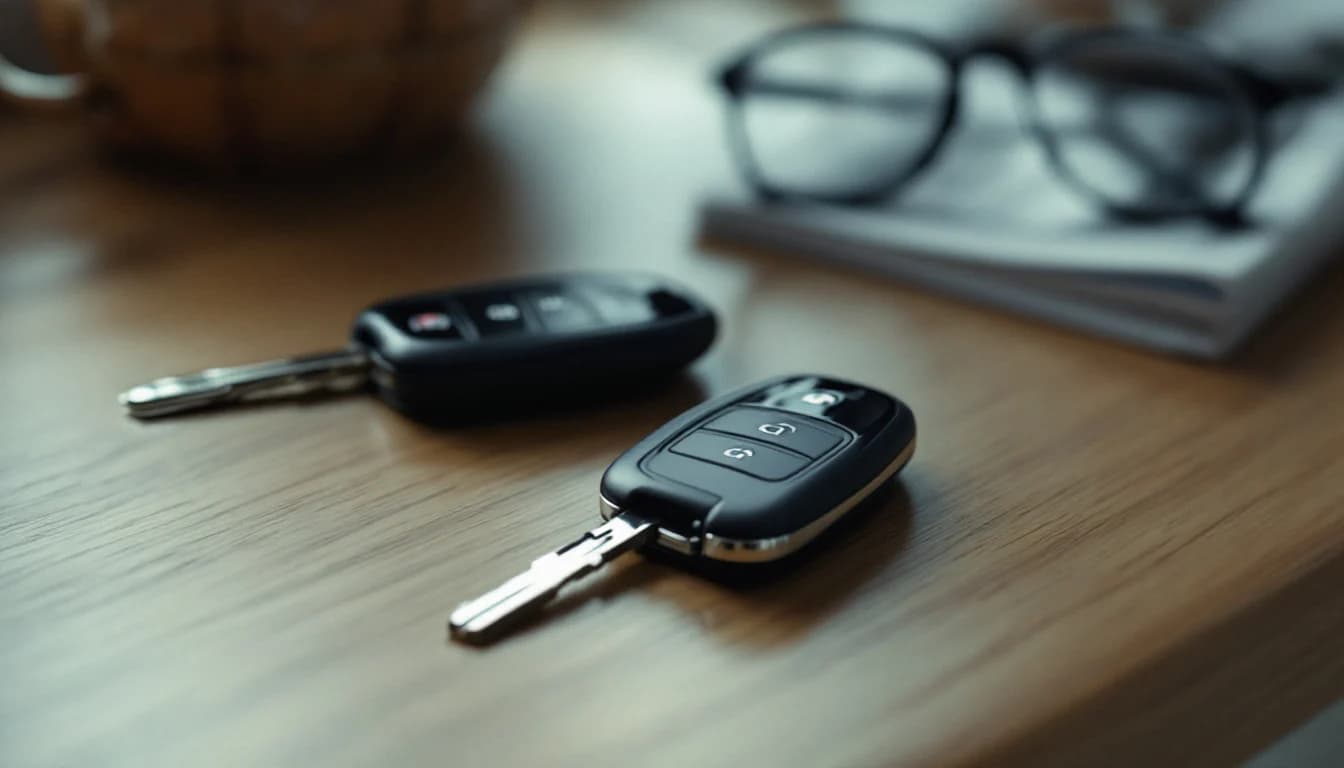
Neither nameplate is uniformly one or the other. Chevrolet has commonly fitted a bladed flip key with an integrated transponder and lock/unlock buttons on lower trims, and a proximity smart fob with push-button start on higher trims and option packages. On the Trailblazer specifically, the entry trims have commonly shipped with the flip key while sportier and better-equipped trims have shipped with keyless access and push-button start. The Blazer skews more heavily toward proximity across its trim range, but that is a tendency, not a guarantee, and it has varied across model years and packages.
The reliable test does not require any brand knowledge:
- Do you insert a physical key into a lock cylinder on the steering column and turn it? That is a bladed transponder or flip key vehicle. Lower band.
- Do you press a start button with the fob simply in your pocket or the cupholder? That is a proximity vehicle. Higher band.
- Does your fob have a small metal blade that slides or folds out of the plastic body, but the car still starts with a button? That is a proximity fob with an emergency blade. Higher band, and the blade still needs cutting for the door.
Fleet and rental-spec vehicles complicate this further. A vehicle originally built for a fleet order can arrive with a different key configuration than the retail brochure suggests for that trim. We see this on used purchases regularly in the Irving and Las Colinas market, where lease returns and former rental units are common.
Our fuller write-up on Chevrolet and GMC key replacement and the theft-deterrent relearn covers the underlying GM security architecture in more depth, and everything we do on these vehicles lives under the Chevrolet brand page and the car key replacement service.
Irving Price Bands for Trailblazer and Blazer Keys, 2026
The table below is the range we quote against locally. Every line assumes verified ownership and a standard-access vehicle, and every number is confirmed against your VIN before work begins.
| Trailblazer / Blazer Scenario | Typical Price Range | What Drives the Number |
|---|---|---|
| Bladed flip key with transponder, spare cut with a working key present | $150–$275 | Blade cut plus chip enrollment; short handshake |
| Bladed flip key with transponder, all keys lost | $250–$400 | Theft-deterrent relearn or security-data access, more labor |
| Proximity smart fob, spare cut with a working key present | $300–$500 | Higher fob cost; proximity enrollment plus emergency blade cut |
| Proximity smart fob, all keys lost | $400–$600 | No trusted credential, longer procedure, higher risk |
| Second spare added at the same visit as the first | Reduced per-key labor | Setup, travel and access already done |
| Emergency lockout only, no key made | $75–$145 | Non-destructive door entry |
| Vehicle with prior module replacement or rebuilt title | Quoted after diagnosis | Mismatched security data becomes a diagnostic job |
Two honest caveats belong beside that table. Very new model-year GM vehicles occasionally require security software the aftermarket has not yet been granted access to, and in those uncommon cases the dealer is genuinely the only path. Anyone who will not tell you that on the phone is planning to discover it in your driveway after collecting a trip fee. Separately, a vehicle with a rebuilt title or a donor body control module can carry security data that does not match the rest of the car, which converts a routine key job into diagnostics. Mention that history when you call.
The Spare-Now vs. All-Keys-Lost Math
Run the arithmetic once and the decision makes itself.
A proximity Blazer spare made today sits in the $300 to $500 band. The same Blazer with all keys lost sits in the $400 to $600 band. On its face that is a difference of roughly $100 to $200, which some owners decide to gamble on. That comparison is incomplete, because it prices only the key.
The all-keys-lost scenario also costs you the following. The vehicle cannot be driven, so if you choose the dealership route you are adding a tow, which commonly runs $150 to $300 in this market before anyone has touched the security system. Dealer key programming for a single key frequently lands in the $500 to $800 range for mainstream models, and appointment availability is real: three to ten business days is a normal wait when the service department is booked and the parts counter has to order a fob. Then add whatever a rental or rideshare costs you for those days.
And it costs you timing. A spare key is a scheduled appointment in your driveway on a Saturday morning. An all-keys-lost call happens in a Belt Line Road parking lot in July, when you are already late for something, with the vehicle full of groceries.
The Associated Locksmiths of America has long promoted the same practical advice trade-wide: the cheapest key you will ever buy is the one you buy before you need it (aloa.org). AAA's consumer guidance on lockouts and key replacement makes a related point about confirming scope and price before work begins rather than in the moment of an emergency (aaa.com).
If the ignition itself is the problem rather than the key — a cylinder that binds, a switch that has to be jiggled — that is a separate job with separate math, and our write-up on Cadillac Escalade and XT5 ignition repair covers how GM ignition faults present on related platforms.
Why the VIN Confirms the Part
Owners hand over a VIN thinking it is paperwork. On a key job it is the opposite: it is the specification.
Those seventeen characters encode how the vehicle was actually built, not how the brochure describes the trim. Specifically, the VIN lets a technician confirm:
- The blank. Which physical key or fob part number this vehicle accepts, including which of several overlapping options was fitted at the plant.
- The cut code. The mechanical bitting for the blade, which is what allows a key to be originated with no existing key to duplicate.
- The security generation. Which theft-deterrent architecture is present, which determines whether the job is a short enrollment or a timed relearn with security-data access.
- The radio configuration. On proximity vehicles, the correct frequency and feature set, including whether remote start or memory functions need to sync to the new fob.
- Parts availability. Whether the correct fob is on the van, in local supply, or a special order that adds a day.
That last one is the practical reason we ask for the VIN before dispatch rather than after arrival. Showing up with the wrong blank helps nobody.
Have your photo ID and proof of ownership ready as well. Texas regulates locksmiths through the Department of Public Safety Private Security program, and verifying that you are entitled to a key for that VIN is a required part of the job, not a courtesy question. Registration, title, insurance card or a lease naming you against that VIN all work. The National Automotive Service Task Force treats controlled access to vehicle security data and verified ownership as baseline professional practice on exactly this class of work (nastf.org). If a quote sounds too good over the phone and then climbs on arrival, that is the pattern the Federal Trade Commission warns consumers about specifically (ftc.gov).
Frequently Asked Questions
How much is a spare key for a Chevrolet Trailblazer in Irving TX?
As of August 2026, a Trailblazer spare made while you still have a working key typically runs $150 to $275 if your trim uses a bladed flip key with a transponder, or $300 to $500 if your trim uses a push-button-start proximity fob. Those numbers include the blank, the cut, the programming and the mobile visit. Final price is confirmed against your VIN before any work starts.
Is the new Chevrolet Blazer key the same as an older Blazer key?
No, and this trips people up constantly. The Blazer sold today is a midsize unibody crossover reintroduced for the 2019 model year, and it uses current GM electronic security. The older truck-based and S-10-based Blazers used entirely different key systems from earlier security generations. Pricing or procedures you find for a 1990s or early-2000s Blazer do not apply to a 2019-or-newer vehicle.
Does my Trailblazer take a flip key or a proximity fob?
Trim and build decide it, not the model year alone. Chevrolet has commonly fitted a bladed flip key with a transponder on entry trims and a proximity smart fob with push-button start on better-equipped trims. The quick test: if you insert a key and turn a cylinder, you have a flip key; if you press a start button with the fob in your pocket, you have a proximity fob. The VIN confirms it definitively.
Why is a spare so much cheaper than replacing all keys lost?
With a working key present, the theft-deterrent module already trusts a credential, so adding another is a short additive operation. With every key gone, the vehicle has to be persuaded from zero, which commonly means a timed relearn or controlled security-data access, more diagnostic time on a vehicle that cannot start, and more risk for the technician. On these Chevrolets that gap is commonly $100 to $200 on the same key type, before the tow you would also be paying for.
Can you program a Chevrolet key without towing the car to a dealer?
Yes. That is the core advantage of mobile service on this job type, and it is worth the most on an all-keys-lost vehicle because the car cannot be driven anywhere. We bring the blanks, the cutting equipment and the programming tools to the vehicle wherever it sits in Irving, Las Colinas, Coppell, Grand Prairie or the surrounding cities, which removes a $150 to $300 tow from the total.
What do I need to have ready before the technician arrives?
Photo identification, proof of ownership tied to that specific VIN such as registration, title, insurance card or a lease, and the 17-character VIN itself. Also be ready to say whether any working key still exists, and whether the vehicle has ever had a body control module replaced or carries a rebuilt title. Both of those change the procedure and should be raised before dispatch, not after.
Should I make two spares at once?
It is usually the better value if you were going to make a second key eventually anyway. The travel, the access, the security procedure and the tooling setup are the same whether one key or two comes out of the visit, so the per-key labor on the second one is lower. Owners who keep one key at home and one in a bag rarely end up making an emergency call at all.
Get a Trailblazer or Blazer Spare Made in Irving
A second key is the cheapest insurance a modern Chevrolet owner can buy, and it is a driveway appointment rather than an emergency. Irving Locksmith Pros cuts and programs Trailblazer and Blazer keys on-site, tests start and remote functions before leaving, and quotes the whole job against your VIN up front.
Call or text 817-842-1751 or email contact@irvinglocksmithpros.com with your year, trim and VIN. With 15+ years of automotive locksmith work behind the van, we would rather tell you honestly on the phone that a specific vehicle needs the dealer than waste your afternoon proving it in your driveway.
References
- National Highway Traffic Safety Administration — vehicle theft prevention and anti-theft technology: https://www.nhtsa.gov
- Insurance Institute for Highway Safety — immobilizer coverage and vehicle theft loss data: https://www.iihs.org
- Associated Locksmiths of America (ALOA) — professional automotive locksmith standards: https://www.aloa.org
- National Automotive Service Task Force (NASTF) — secure vehicle security-data access and ownership verification: https://www.nastf.org
- Federal Trade Commission — hiring a locksmith and avoiding estimate scams: https://www.ftc.gov
- AAA — consumer guidance on car keys, lockouts and roadside service: https://www.aaa.com
Reviewed by a licensed automotive locksmith technician at Irving Locksmith Pros. Texas DPS Private Security regulated. Mobile service; ownership verification required.