Hotel Guest Car Lockout in Las Colinas & Irving TX: A Traveler's Guide
2026 traveler's guide to a car lockout at an Irving or Las Colinas hotel — what the front desk can do, garage access, ownership proof, real costs.
Locked Out of Your Car at a Hotel in Irving or Las Colinas
The scenario repeats itself along Highway 114 every week. A traveler checks into a hotel in the Las Colinas Urban Center or one of the properties clustered near the DFW airport corridor, unloads bags, grabs dinner — and somewhere in that shuffle the car keys end up on the wrong side of a locked door. Sometimes they're visible on the driver's seat. Sometimes they're in a laptop bag in the trunk. Sometimes they're just gone, last seen at a restaurant on Lake Carolyn.
If that's you tonight, the good news: this is one of the most solvable problems in travel. As of July 2026, a mobile car lockout in the Irving and Las Colinas area runs $75–$145, is handled non-destructively, and usually takes less time than the room-service order you abandoned to deal with it. This guide is built as a decision path for a traveler standing in a hotel lobby: what the front desk can and can't do, how valet versus self-park changes things, how a locksmith actually reaches your car inside a parking structure, and — the part travelers worry about most — how ownership verification works when your registration is sitting in the glovebox of the locked car.
One thing this guide won't do is name hotels. The advice is the same across the corridor's properties, and your situation depends far more on how you parked than where you're staying. And if you'd rather have the problem moving while you read, call or text 817-842-1751 — we dispatch across the corridor day and night.
Step 1: What the Front Desk Can and Can't Do
Start at the desk — but calibrate your expectations. Hotel staff deal with guest car trouble constantly, and a good front desk is genuinely useful for three things:
- Local knowledge and logistics. They know which garage levels have clearance for service vehicles, where a locksmith should park, which entrance is closest to your spot, and how after-hours garage access works.
- A safe place to wait. A lit lobby with coffee beats standing next to your car in a concrete structure at midnight.
- Coordinating with valet. If your car is valet-parked, the desk connects you to the valet stand, which matters enormously (next section).
What the front desk cannot do is open your car. Hotels don't keep lockout tools, staff aren't trained or insured for vehicle entry, and no competent property will slim-jim a guest's vehicle — modern cars with side-curtain airbags and complex door electronics can be damaged badly by improvised entry attempts, which is precisely why professional associations urge consumers toward trained, licensed technicians instead of DIY methods (aloa.org). Some hotels keep a list of local service providers; treat that list as a starting point, not a vetting service, and apply the same checks you'd apply to any locksmith — the Federal Trade Commission specifically advises confirming identification, licensing, and a clear price before work begins (ftc.gov). In Texas, that license traces to the Department of Public Safety's Private Security Program (dps.texas.gov) — you can and should ask for it.
Step 2: Valet or Self-Park? It Changes Everything
If you valet-parked: stop and think before calling anyone. Your keys may not be locked in the car at all — they may be hanging on a board at the valet stand. Travelers who "lose" keys at hotels have, more than once, simply forgotten they handed them over at the porte cochère eight hours earlier. Ask the valet first. And if the keys are locked inside the car (you took them, then locked them in during a luggage trip), the valet team still matters: they control where the car sits, they can often move nearby vehicles to give a technician working room, and they'll want to log the service visit.
If you self-parked in a surface lot: easiest case. Send us a pin, a photo of the car, and the lot entrance you used. Surface lots off 114 and around the Urban Center have no access complications.
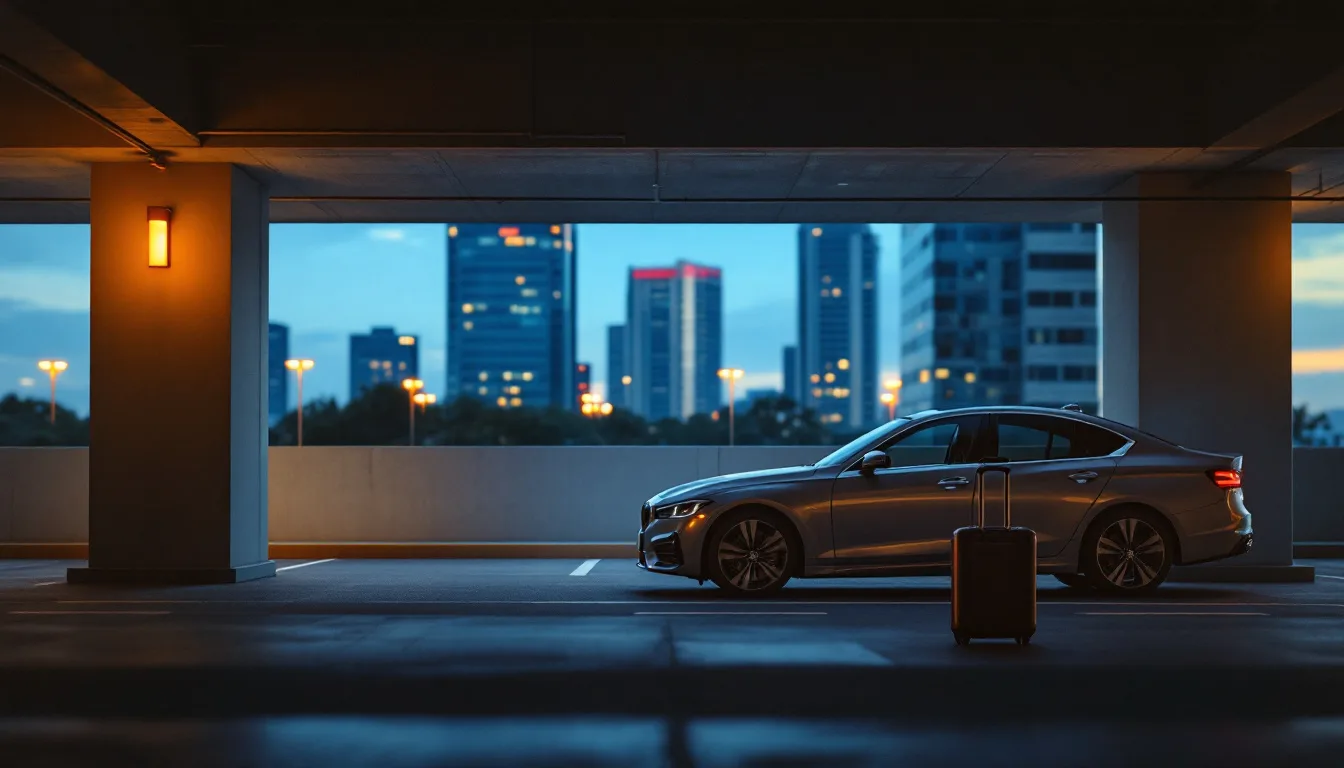
If you self-parked in a structure: this is where five minutes of prep saves half an hour. Parking garages in the Las Colinas high-rise district have entry clearances that a full-height service van may not fit under — most are fine for our vehicles, but it's worth telling us the posted clearance if you can see it. More practically: note your level and space number, whether the garage requires a room key or ticket to walk in, and which stair or elevator core is nearest your car. A technician who has to circle a five-level structure hunting for a gray sedan among two hundred gray sedans is a technician you're paying to wander. The pin-drop plus "Level 3, northeast corner, near the B elevator" version of the call gets opened fastest. More on how we cover this district specifically: Las Colinas service area.
Step 3: Understand What "Non-Destructive Entry" Means
Travelers sometimes brace for drama — broken windows, pried doors. That's not how professional lockout work operates. Licensed automotive locksmiths open modern vehicles with purpose-built tools that manipulate the lock or latch mechanisms the way the manufacturer intended them to move, without damaging paint, weatherstripping, or the door electronics. It's the same reason roadside organizations that handle millions of annual lockout calls emphasize professional response over coat-hanger improvisation (aaa.com): the entry itself is quick and safe when done by someone who does it daily, and expensive when done by someone who watched a video once.
Vehicle security has also simply gotten better. Anti-theft architecture that the National Highway Traffic Safety Administration and the Insurance Institute for Highway Safety have tracked across the modern fleet — immobilizers, encrypted fobs, deadlocking systems — makes cars dramatically harder to steal, and as a side effect, harder to open without the right tools and training (nhtsa.gov, iihs.org). That's a feature, not a bug. It's also why the $75–$145 you pay a professional is buying skill, not a wire hook.
Step 4: The Ownership Question — Answered in the Right Order
Here's the worry we hear from travelers more than any other: "My registration is in the glovebox. My rental agreement is in the console. How do I prove the car is mine when everything that proves it is locked inside it?"
The answer is that verification happens in the correct sequence, and the sequence solves the paradox:
- We open the car first. A lockout is entry, not key creation. Standard practice is to confirm your identity, document the service, and note the vehicle.
- Then documents come out of the glovebox. Once the door is open, the registration or rental agreement is in your hand, and the match between your ID, the documents, and the vehicle is confirmed on the spot.
- Only after verification would any key ever be made. If your problem turns out to be bigger than a lockout — the keys aren't in the car at all — no replacement key gets cut or programmed until ownership is properly established. That's non-negotiable, it's the standard the professional bodies that govern automotive security data access are built on (nastf.org), and it protects you: the same discipline that slows down a stressed traveler at 11 PM is what stops someone else from having a key made to your car in your driveway.
If the car is a rental, entry works the same way — but any lost-key replacement runs through the rental company's authorization, a scenario with its own playbook we've written up separately.
What This Costs, in Context
| Situation at Your Hotel | Typical Resolution | Cost Band (July 2026) |
|---|---|---|
| Keys visible inside, self-parked | Mobile non-destructive lockout | $75–$145 |
| Keys inside, valet-parked | Valet coordination + lockout | $75–$145 |
| Keys in locked trunk | Cabin entry + trunk release | $75–$145 |
| Keys genuinely lost, basic transponder vehicle | Open + verify + new key | $150–$275 |
| Keys lost, smart/proximity fob (domestic or Asian brand) | Open + verify + fob programming | $300–$500 |
| Keys lost, European vehicle (BMW, Mercedes, Audi and similar) | Open + verify + European smart key | $400–$700 |
Two notes on the table. First, the lockout band covers the overwhelming majority of hotel calls — most travelers know exactly where the keys are: inside. Second, if keys are truly lost, the alternative to those key-replacement bands is a dealer path that typically runs $500–$800 for a single key plus a $150–$300 tow — a rough combination when your car is on Level 4 of a structure and you're due at a conference at eight. The full breakdown lives in our car key replacement cost guide.
The Business Traveler's Clock
The corridor between the Urban Center and the airport hotels runs on tight schedules, so let's talk about the two time-pressure scenarios we see most.
The early-flight lockout. You're loading the car at 5:15 AM for a 7:10 departure and the doors lock with everything inside. Call immediately — don't spend twenty minutes on hopeful pocket-searching. Early-morning response in the Irving core is typically fast precisely because traffic hasn't built, and a straightforward open can still have you on International Parkway with margin. If the math truly doesn't work, the fallback decision is clean: rideshare to the terminal now, deal with the car on your return, and tell the hotel so the vehicle isn't flagged. A parked, locked car is safe; a missed flight is expensive.
The mid-conference lockout. Keys locked in the car at lunch, sessions all afternoon. This is the easy one: you don't need to stand at the car. We coordinate arrival, you step out of the ballroom for ten minutes at the right moment, identity and service get handled, and you're back before the next keynote. Mobile service means the car's location matters, not yours — within reason and within sight of the work, since you do need to be present.
"Hotel garage calls are ninety percent logistics, ten percent lock work. The open takes minutes. Finding one specific white crossover on the wrong level at midnight because the caller said 'it's in the garage' — that's the slow part. Level, space number, nearest elevator. Give me those three things and you're back in the car before your coffee's cold." — a Texas DPS-licensed automotive locksmith technician on our team
Prevention for the Frequent Traveler
You can't spare-key your way out of every problem on the road, but travelers have a few habits worth stealing:
- Pocket-check at every door. Phone, wallet, keys — before any car door or trunk closes, every time. Boring, and it works.
- Keep the fob and the luggage separated. Most hotel lockouts happen during loading and unloading, when the fob gets set down "for one second" on a seat or in a trunk. Keys go in a pocket or clip, never in the cargo area.
- Know your car's auto-lock behavior. Some vehicles auto-lock on walk-away; combined with a fob buried in a duffel bag in the trunk, that's a trap. Check the setting before a trip in an unfamiliar or new vehicle.
- Photograph your documents. A phone photo of your registration and insurance card doesn't replace originals, but it speeds every verification conversation you'll ever have on the road.
- Save a local number before you need it. If Irving is a regular stop on your rotation, put ours in your phone. If your trouble ever escalates past a lockout — an ignition acting up, a fob dying — the same mobile model covers emergency locksmith response and full automotive locksmith services at your hotel, without a tow.
Locked Out at Your Hotel Right Now?
Whether you're in the Las Colinas Urban Center, along the 114 hotel corridor, or anywhere in Irving and the surrounding DFW cities, we come to your exact parking spot — surface lot, valet lane, or Level 5 of a structure — and open your car without damage. $75–$145, mobile, usually within the hour.
Call or text 817-842-1751 or email contact@irvinglocksmithpros.com. Tell us the cross street, the garage level, and what you drive — we'll handle the rest.
Frequently Asked Questions
Can the hotel front desk unlock my car?
No. Hotels don't keep vehicle-entry tools and staff aren't trained or insured to open cars — improvised attempts risk real damage to modern door electronics and trim. What the desk can do is valuable logistics: garage access, valet coordination, a safe place to wait, and directions for the locksmith. The actual entry should be done by a licensed professional.
How much does a car lockout cost at an Irving or Las Colinas hotel?
As of July 2026, a standard non-destructive mobile lockout in the Irving area runs $75–$145, whether the car is in a surface lot, a valet lane, or a parking structure. If keys are genuinely lost rather than locked inside, replacement adds $150–$275 for a basic transponder key, $300–$500 for a smart fob, or $400–$700 for European smart keys.
Can a locksmith get into a hotel parking garage?
Almost always, yes. Most structures in the Las Colinas and airport-corridor district accommodate service vehicles, and hotel staff routinely coordinate access. Help by reporting the garage's posted clearance if visible, your level and space number, and whether walk-in access requires a room key or ticket — those details are what determine how fast the technician reaches your car.
How do I prove the car is mine if my registration is locked inside it?
Verification happens in the right order. The lockout itself is entry, not key-making: the technician confirms your identity and documents the service, opens the car, and then the registration comes out of the glovebox to complete the match. If any replacement key were needed, it would only be made after ownership verification is complete — that sequence protects you and every other owner.
What if my keys are locked in the trunk?
Trunks are opened through the cabin, not forced. Once the technician opens the doors non-destructively, the trunk is released via the interior release or fold-down access, which keeps the job inside the standard $75–$145 lockout band. No drilling, no pried metal.
I have a flight at DFW in two hours. Is a lockout fixable in time?
Often, yes — early-morning response in the Irving core is quick, and the open itself takes minutes once the technician is at the car. Call immediately rather than searching pockets for twenty minutes first. If the timing truly fails, take a rideshare to the terminal, notify the hotel, and resolve the car on your return; a locked car in a hotel garage is safe where it sits.
Should I use the locksmith the hotel recommends?
Treat any recommendation as a lead, not a guarantee. Apply the same checks you'd use anywhere: a Texas DPS Private Security license, a clear up-front price band, identification on arrival, and non-destructive methods. The FTC's consumer guidance on locksmith services says the same — verify credentials and get the price before work begins, no matter who made the referral.
References
- Federal Trade Commission — hiring a locksmith and avoiding scams: https://www.ftc.gov
- Texas Department of Public Safety — Private Security Program licensing: https://www.dps.texas.gov
- Associated Locksmiths of America (ALOA) — professional standards: https://www.aloa.org
- AAA — lockout and roadside assistance guidance: https://www.aaa.com
- National Highway Traffic Safety Administration — vehicle anti-theft systems: https://www.nhtsa.gov
- Insurance Institute for Highway Safety — vehicle security technology: https://www.iihs.org
- National Automotive Service Task Force (NASTF) — secure security-data access: https://www.nastf.org
Reviewed by a licensed automotive locksmith technician at Irving Locksmith Pros. Texas DPS Private Security regulated. Mobile service; ownership verification required.