
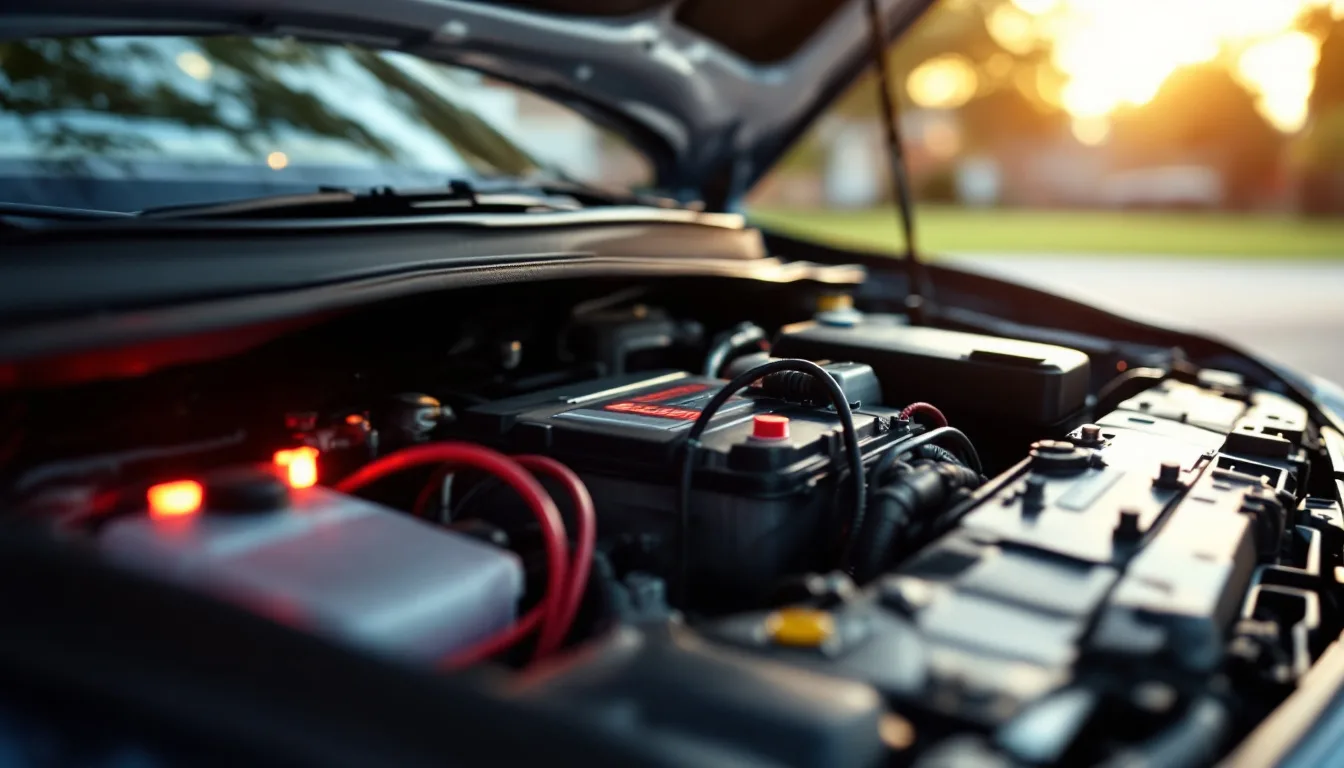
Car Won't Start After Battery Change? Irving TX Relearn Fix
2026 guide to a car that won't start after a battery change or jump start in Irving TX. Immobilizer relearns, Passlock, steering lock, locksmith vs mechanic.
New Battery, Dead Car: Why a Simple Swap Can Wake the Anti-Theft System
You did the responsible thing. The old 12-volt battery was five Texas summers old, so you swapped it in the driveway — or the shop did it, or a parking-lot jump start got you home. And now the car is worse than before: it cranks strong and refuses to run, or it starts and dies in two seconds, or it won't even acknowledge the key while a little padlock or "SECURITY" light blinks at you like it knows something you don't.
To be clear about scope up front: this article is about the car's 12-volt battery — the big one under the hood — not the coin cell inside your key fob. (We've covered changing the fob battery separately.) A dying fob cell causes "key not detected" complaints; a 12V power interruption causes a different, more confusing family of problems, because several of your car's control modules lose power mid-thought and wake up suspicious.
Reviewed and updated as of August 2026. Irving Locksmith Pros handles these post-battery-change no-starts across Irving, Las Colinas, Grand Prairie, and the surrounding DFW cities — often as a quick relearn rather than a parts bill. This guide sorts the harmless relearns from the genuine security lockouts, walks the GM Passlock case in detail, and tells you honestly which calls belong to a locksmith and which belong to a mechanic.
One addition in this revision, because it has become the most common version of this call: dual-battery diesel trucks fail differently. Two batteries in parallel can disagree about their state of health, the voltage collapse during a diesel crank is far deeper than on a car, and replacing one battery of a pair leaves the truck marginal. If that describes your vehicle, go to HD diesel will not start after a battery swap or jump instead - the diagnostic order is different. And if the truck will not crank at all rather than cranking and refusing to run, an interlock may be involved: ignition switch vs interlock vs immobilizer on HD trucks walks that fork.
Current pricing as of August 2026 is unchanged: many relearns cost little or nothing, and where keys must be regenerated our published bands apply - $150-$275 for a transponder key and $300-$500 for a smart or proximity fob.
If your car is stranded right now: crank duration, dash lights, and whether it dies immediately are the three details to have ready. Call or text 817-842-1751.
What Actually Happens When the 12V Goes Away
Modern vehicles keep dozens of modules on a shared network, and several of them hold "learned" values in volatile memory — data that evaporates when power is cut. Disconnect the battery and the car forgets a small collection of things it taught itself: idle air trims, throttle-position adaptations, window one-touch limits, radio presets, and — on some platforms — the current state of handshakes inside the theft-deterrent chain. Vehicle electrical architectures are engineered to tolerate power loss (this territory is covered extensively in SAE's standards work on road-vehicle electrical systems), but "tolerate" means recoverable, not seamless (sae.org).
The immobilizer itself — the system that checks your key's transponder before authorizing fuel and spark, which federal safety regulators credit with dramatic theft reductions (nhtsa.gov) — stores its key list in non-volatile memory. Your keys are not erased by a battery change. That's worth saying twice, because it's the fear behind most of these calls: a battery swap does not deprogram your keys. What a power cycle can do is interrupt the theft-deterrent system's learned reference values or leave a module in a tamper-flagged state, and the vehicle responds the way it's designed to respond to possible tampering: it lets the engine crank but withholds fuel or spark, or kills it seconds after start.
The result is a car with a brand-new battery, perfect compression, and a security system standing in the doorway with its arms crossed.
The Three Post-Battery No-Start Families
Family one: harmless relearns that fix themselves. Rough idle, stalling at stoplights, a high or hunting idle — that's the engine computer re-learning throttle and idle trims, and it settles within a few drive cycles on most cars. Some Nissan and Honda models are famous for a wandering idle after battery disconnection until their idle-relearn procedure (a specific sequence of key-on, warm-up, and idle time) is performed. Annoying, occasionally worth a shop visit if it won't settle — but not a security problem and not a locksmith problem. If the car runs, you're probably here.
Family two: theft-deterrent lockouts. The car cranks but won't run, or starts and dies in one to three seconds, with the security/padlock light solid or flashing. This is the immobilizer or an analog theft-deterrent (like GM's Passlock) refusing authorization. Some versions clear with a documented timed relearn you can do in the driveway; some need diagnostic tooling to reset a tamper state or re-sync a module. This family is locksmith territory.
Family three: power-loss side effects that look like lockouts. A steering column locked hard against the key, a shifter interlock that won't leave Park, a start button that ignores a fob whose battery chose the same week to die, or — the classic — corroded battery terminals delivering twelve volts to the dash and not enough amperage to crank. Each has its own quick check, below, and none of them means your car "lost its programming."
The GM Passlock Case: A 10-Minute Relearn That Saves a Tow
If you drive an early-2000s-era GM — Malibu, Impala, Cavalier, S-10, Grand Am, and their many siblings — the post-battery no-start has a signature: cranks fine, starts and instantly dies (or won't fire at all), with the SECURITY light glowing. Passlock isn't a transponder system; it reads a resistance signal from the lock cylinder itself, and a power interruption (or a marginal battery during the swap, or a jump start gone sideways) can desynchronize the learned value. We've written a full deep-dive on GM security-light no-starts and Passlock; the short version of the relearn:
- Turn the key to ON (not start). The SECURITY light comes on.
- Wait approximately 10 minutes until the light goes out or stops flashing.
- Key OFF for about 10 seconds. Repeat the ON-and-wait cycle two more times — three 10-minute cycles total.
- On the fourth key-on, start the car. The system has re-learned the cylinder's value.
Thirty minutes of your time, zero dollars, and it resolves a large share of these calls. If the relearn won't take — or the SECURITY light keeps returning on random mornings — the lock cylinder's Passlock sensor itself is likely failing, which is a genuine repair (and one a locksmith handles, since it's the lock cylinder). AAA's roadside statistics have long shown battery trouble as the single most common call category (aaa.com); in North Texas, where heat murders batteries early — often in year three or four of life here — these relearn scenarios cluster in exactly the summer weeks we're in now.
"Half my 'won't start after new battery' calls end without me touching a tool — we do a timed relearn together on the phone, or I find a loose terminal the parts-store swap left behind. The other half are real: a tamper flag that needs a scan tool, a Passlock sensor that's actually dying, a steering lock module that picked power-loss day to fail. The skill is telling those apart before anyone pays for parts." — A licensed automotive locksmith on our Irving team
Quick Checks Before You Call Anyone
Run these in order — they're free and they sort most cases:
- Terminals first. Are both clamps tight enough that you can't rotate them by hand? A swap-day loose ground produces every symptom on this page. Check for corrosion and for a missed engine-ground strap.
- Read the dash. Solid or flashing security/padlock light while cranking = theft-deterrent family. No dash lights at all = power delivery, not security.
- Try the spare key. If the spare starts the car, your primary key's transponder or its fob battery is the problem — a much smaller job.
- Steering wheel jammed? Push-pull the wheel firmly while turning the key; a loaded column lock binds after power loss. On push-to-start cars, a whirring-then-silence from the column can be the electronic steering lock module — a known failure that power cycling exposes.
- Fob battery. Power-loss coincidences happen: if the dash says "key not detected," hold the fob against the start button or the marked backup spot and try again. If that works, it's the coin cell — see our fob battery guide above.
- Dying in 1–3 seconds repeatedly? Stop cranking. That's the immobilizer/theft-deterrent pattern, and repeated attempts on some platforms extend the lockout timer.
The Federal Trade Commission's general auto-repair consumer guidance applies squarely here: describe symptoms, ask for the diagnosis before authorizing parts, and get the estimate in writing (ftc.gov) — because the most common failure in this scenario isn't the car's, it's a $600 parts cannon fired at a ten-minute relearn.
Locksmith or Mechanic? An Honest Division of Labor
| Symptom After Battery Change / Jump | Likely System | Who Handles It | Typical 2026 Cost (Irving, mobile) |
|---|---|---|---|
| Cranks, starts, dies in 1–3 sec; security light | Immobilizer / Passlock relearn or tamper reset | Locksmith | $0 DIY timed relearn; $95–$225 tooled reset/diagnosis |
| Security light returns randomly; intermittent no-start | Failing Passlock sensor / lock cylinder | Locksmith | $180–$400 cylinder work, quoted after inspection |
| "No key detected" but backup-position start works | Fob coin cell | You (or us in minutes) | $10–$75 |
| Key won't turn; wheel locked hard | Mechanical steering lock bind | You (push-pull technique), else locksmith | $0–$145 |
| Push-to-start: column whirs or silent, "steering lock" warning | Electronic steering lock module | Locksmith (module work) | Honest range after VIN/module inspection |
| No crank, no dash lights, clicking | Terminals, ground strap, or the new battery itself | You / parts store / mechanic | $0–$50 |
| Runs but idles rough or stalls at lights | Idle/throttle relearn (Nissan, Honda, others) | Usually self-heals; mechanic if persistent | $0; shop relearn if needed |
| Check-engine light with misfires after jump start | Engine management — possible surge damage | Mechanic | Shop diagnosis |
Where the line actually sits: keys, immobilizers, lock cylinders, steering locks, and security-module relearns are locksmith work; fuel, spark, sensors, and drivability are mechanic work. The overlap zone is the start-and-die pattern, and the honest answer there is diagnosis first. If a module was genuinely damaged by a voltage spike during a botched jump — it happens, and insurance-industry research on vehicle electronics complexity keeps documenting how much more of the car's function now routes through them (iihs.org) — module-level repair or replacement gets an honest range with the exact quote after VIN and module inspection. Our no-key-detected and immobilizer service is the front door for the security-side cases; if you're stranded somewhere awkward, emergency locksmith response comes to the car.
One more honest note: some 2015+ vehicles and brand-new model years tie security-system resets to dealer-only software. A tech confirms your exact setup after the VIN — before you pay for a van to roll.
Preventing the Sequel: Battery Changes Without Drama
- Use a memory saver — a small device that feeds the car 12V through the OBD port or accessory socket during the swap. Most parts stores sell them for less than a tow costs. It preserves learned values and sidesteps the entire relearn family.
- Jump-start by the book: correct terminal order, grounds last and away from the battery, and let the donor car charge the dead one for a few minutes before cranking. Voltage spikes during careless jumps are the origin story of a share of genuine module failures. National traffic-safety guidance on vehicle maintenance basics exists for a reason (nhtsa.gov).
- Replace proactively in year four. DFW heat kills batteries from the inside; a battery that survives four North Texas summers is on borrowed time, and a proactive swap on your schedule beats a parking-lot jump on the car's schedule.
- Keep the spare key findable. Post-power-loss is exactly when a marginal transponder key finally fails; the spare turns a crisis into a comparison test.
Frequently Asked Questions
Why won't my car start after I replaced the battery?
Usually one of three things: a loose terminal or ground from the swap itself, a theft-deterrent system that lost its learned values during the power cut and needs a relearn, or a coincidental failure (fob battery, steering lock module, or the new battery being defective). If it cranks but dies with a security light showing, it's the theft-deterrent family — often fixable with a timed relearn procedure before anyone buys parts.
Did changing the battery erase my key programming?
No. The immobilizer stores its authorized-key list in non-volatile memory that survives power loss, so your keys remain programmed. What a power cycle can disturb is the theft-deterrent system's learned reference values or a tamper flag, which blocks starting until a relearn or reset is performed — a different and much cheaper problem than reprogramming keys.
How do I do the GM Passlock relearn after a battery change?
Turn the key to ON without starting and leave it until the SECURITY light goes out — about 10 minutes. Switch OFF for 10 seconds, then repeat the cycle twice more, for three 10-minute cycles in total. On the next key-on the system has relearned its value and the car should start. If the relearn won't hold or the light keeps coming back, the Passlock sensor in the lock cylinder is likely failing and needs repair.
My car starts and immediately dies after a jump start. What's happening?
Start-and-die within one to three seconds is the classic immobilizer/theft-deterrent refusal: the engine is allowed to crank but the system withholds fuel or spark authorization. After a jump start it's usually a desynchronized theft-deterrent value or a tamper flag rather than damage. Stop repeated attempts — some systems extend the lockout — and either run your model's documented relearn or have it reset with diagnostic tooling.
When is a no-start after battery change a locksmith job versus a mechanic job?
Locksmith: security lights, start-and-die patterns, keys that won't turn, steering-lock faults, no-key-detected messages, lock cylinder and immobilizer resets. Mechanic: rough running, misfires, check-engine drivability codes, and anything fuel-or-spark once the security system has authorized the start. The start-and-die overlap gets diagnosed first — a scan tool distinguishes a security refusal from an engine fault in minutes.
Can a jump start damage my car's modules?
It can, though it's the exception. Reversed clamps or spike-prone jumping can damage electronic modules, and symptoms range from warning lights to a genuine no-start. Most post-jump no-starts are still relearn or terminal issues, so diagnose before replacing anything. If a module is damaged, repair or replacement is quoted as an honest range with the exact number after VIN and module inspection.
How much does an immobilizer relearn cost in Irving TX?
As of July 2026: documented timed relearns like GM Passlock cost nothing but 30 minutes if you do them yourself, tooled security resets and diagnosis typically run $95 to $225 mobile, and lock-cylinder repairs (for failing Passlock sensors and similar) run roughly $180 to $400 depending on the vehicle. Module-level work is quoted after inspection. Final price is always confirmed against your VIN.
Cranks But Won't Run? Get It Diagnosed in Your Driveway
A no-start after a battery change is usually a relearn, a terminal, or a ten-minute reset — not a new module and not a tow. Irving Locksmith Pros diagnoses the security side on-site across Irving, Las Colinas, Grand Prairie, and the surrounding DFW cities, and we'll tell you honestly when the answer is a mechanic instead.
Call or text 817-842-1751 or email contact@irvinglocksmithpros.com with your year, make, model, and exactly what the car does when you try to start it. We'll often sort the harmless from the real before the van ever rolls.
References
- National Highway Traffic Safety Administration — vehicle theft prevention and maintenance safety guidance: https://www.nhtsa.gov
- AAA — battery failure and roadside assistance statistics: https://www.aaa.com
- SAE International — road vehicle electrical system standards: https://www.sae.org
- Federal Trade Commission — auto repair consumer guidance: https://www.ftc.gov
- Insurance Institute for Highway Safety — vehicle electronics and loss research: https://www.iihs.org
- Associated Locksmiths of America (ALOA) — professional automotive locksmith standards: https://www.aloa.org
Reviewed by a licensed automotive locksmith technician at Irving Locksmith Pros. Texas DPS Private Security regulated. Mobile service; ownership verification required.