
Car Won't Start After Long-Term Airport Parking: Irving TX Triage Guide
2026 triage guide for a car that won't start after weeks in DFW long-term parking — dead battery vs dead fob vs immobilizer fault, and who to call.
Back From Vacation, and the Car Is Dead in Long-Term Parking
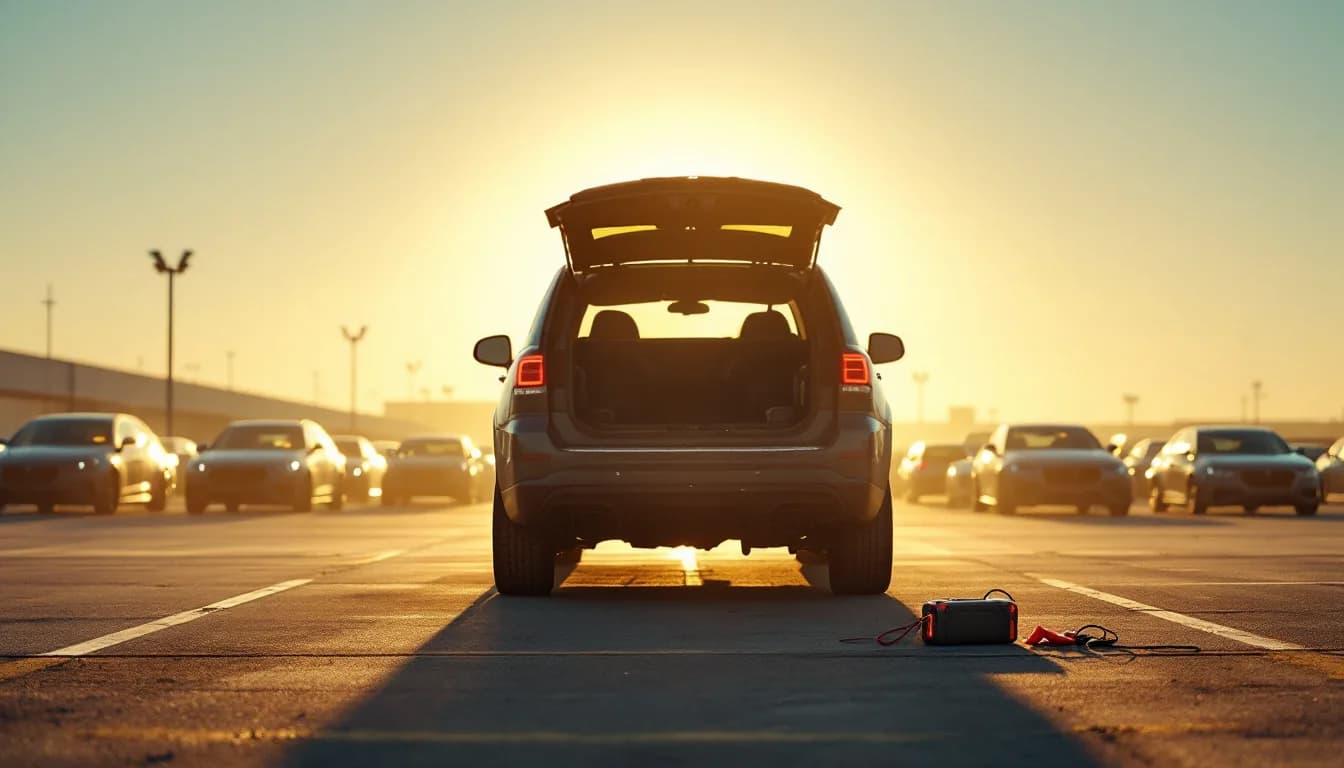
There is a specific silence every frequent flyer dreads. You've landed at DFW after one, two, three weeks away. You've dragged the bags onto the shuttle, found your row in long-term or remote parking, pressed the start button — and gotten nothing. Or a rapid clicking. Or every warning light at once and a Key Not Detected message that wasn't there when you left.
Take a breath: this is one of the most diagnosable failures in all of car trouble, because the cause list after long-term parking is short and ordered. As of July 2026, this guide is the triage ladder we talk stranded travelers through by phone from our Irving base — a five-minute sequence that tells you whether you're facing a jump-start, a two-dollar coin cell, or a genuine key/immobilizer problem, and therefore whether you need a battery service, a locksmith, or neither. Work it in order; each rung rules out the one above it. And if you'd rather have company on the ladder, call or text 817-842-1751 — we answer around the clock.
Rung 1: The 12V Battery — the Cause Most of the Time
Start with the overwhelming favorite. A car sitting for one to three weeks isn't fully off; dozens of modules maintain a small parasitic draw — alarm, telematics, keyless-entry receivers all sip current around the clock. A healthy battery shrugs that off for weeks. A battery that's three Texas summers old may not — and heat is the quiet killer here: sustained high temperatures accelerate the internal degradation of lead-acid batteries, which is why batteries in North Texas tend to age faster than the national average and why AAA has long flagged hot-climate battery aging as a leading cause of no-starts (aaa.com). Your car spent the entire trip baking in a concrete oven off International Parkway in July. The battery did not enjoy the vacation as much as you did.
The fingerprints of a dead or dying 12V battery:
- No response at all, or a single click, or rapid machine-gun clicking when you try to start.
- Interior lights dim or dead; the dash flickers or cycles strangely.
- Key-fob buttons don't wake the car (though see Rung 2 — this overlaps).
- On push-button cars: a cascade of unrelated warning messages. Low system voltage confuses modules into reporting phantom faults — a dying battery routinely impersonates five other problems.
What to do: a jump-start or battery service, not a locksmith. Airport parking operations frequently offer or can summon jump assistance — ask the booth attendant or call the number posted on the garage pillars — and roadside services handle these lots all day. If the car starts and drives, get the battery tested promptly rather than trusting one good drive home; a battery that died in a garage will die again in your driveway.
One warning before you hook up cables borrowed from a stranger: modern vehicles are electronically delicate, and reversed or sloppy jump connections can damage control modules — turning a $150 battery problem into a four-figure electronics problem. If you're not confident, let a service do it. The engineering that makes modern cars efficient and clean-running — the same electronic engine management the EPA's emissions framework has driven for decades (epa.gov) — is also what makes them intolerant of amateur electrics.
Rung 2: The Fob's Coin Cell — the Two-Dollar Impostor
If the car's interior lights come on strong and the dash wakes normally but the car says Key Not Detected or simply won't acknowledge the fob — suspect the fob's own battery before anything exotic. Coin cells (typically CR2032-class) die of old age and heat just like their bigger cousin under the hood, and a fob that was marginal before your trip can finish dying while sitting in your carry-on for two weeks.
The fingerprints: remote buttons stopped working or only work from an inch away; the car intermittently detected the key in the weeks before your trip; "Key Not Detected" on a car whose dash otherwise looks healthy and bright.
The escape hatch almost nobody knows: virtually every push-button car has a documented backup start position for exactly this failure. On many vehicles, you hold the fob directly against the start button and press; on others, there's a marked pocket in the console or a slot the fob sits in; on others still, the procedure is fob-against-steering-column. The passive-start system includes a short-range backup coupling that works even with a completely dead fob battery — a deliberate piece of keyless-system engineering (sae.org). The exact spot is in your owner's manual under "key fob battery" or "starting with a dead fob battery," and it's worth finding right now, in the garage, on your phone's copy of the manual.
If the backup position starts the car: drive home, swap the coin cell tonight. Our step-by-step fob battery guide covers the common fob styles, and the swap is genuinely a two-minute, two-dollar fix. If fresh-battery-plus-backup-position still gets nothing, continue down the ladder.
Rung 3: The Ugly Middle — Immobilizer Faults After Battery Events
Here's the rung that generates our strangest calls, and it usually happens after someone "fixed" Rung 1. The car got jumped, cranks strong now — and still won't start. Or starts and immediately dies. The security light stays lit or flashes; the dash may say Key Not Detected or show an immobilizer warning even though the fob battery is fine.
What happened: deep discharge and the voltage sag or spikes of a jump-start can leave the immobilizer system confused. The anti-theft handshake between fob, receiver, and engine control modules — the architecture federal regulators credit with driving vehicle theft down across the modern fleet (nhtsa.gov) — depends on modules that came through the power event with their security state intact. Sometimes one didn't. The result is a car that is mechanically perfect, electrically revived, and cryptographically convinced it's being stolen.
The fingerprints: cranks but won't fire (or fires and stalls in a second or two) after a jump or battery replacement; security/key warning lamp active; remote and entry functions possibly working fine while start authorization fails.
What to do: this is locksmith territory, not battery territory — and not necessarily dealer territory either. Diagnosing and resetting immobilizer state, re-synchronizing keys, and handling the security-data side of the repair is core work for a properly equipped automotive locksmith operating within the trade's security-access frameworks (aloa.org, nastf.org). We handle these as no-key-detected and immobilizer faults, mobile, including in airport-area garages. Persistent faults that trace into damaged modules escalate to module repair and programming — rarer, but it's the honest end of this branch.
Rung 4: Actual Key Problems
Last rung, least common in the parking-garage scenario, but real: the key itself. A fob that got crushed in a bag, soaked at a beach resort, or simply failed internally; a transponder chip that died; a bladed key that no longer turns a worn ignition. If a known-good vehicle battery, a fresh coin cell, and the backup start position all fail — and no immobilizer fault pattern fits — the key or the ignition hardware is the suspect. Water-damaged and physically broken fobs generally need replacement rather than repair, which lands in the standard bands: $150–$275 basic transponder, $300–$500 smart/proximity fob, $400–$700 European smart keys. Worn ignitions are their own repairable problem — see ignition repair.
The Five-Minute Decision Table
| What You Observe in the Garage | Most Likely Cause | Who You Need |
|---|---|---|
| Nothing/clicking; dim or dead interior lights | Dead 12V battery | Jump/battery service |
| Dash healthy; "Key Not Detected"; remote buttons weak or dead | Dead fob coin cell | Backup start position now; coin cell tonight |
| Cranks strong but won't fire after a jump; security lamp active | Immobilizer/security fault from the power event | Automotive locksmith (mobile) |
| Fob crushed, soaked, or dead with fresh battery | Failed fob/transponder | Locksmith — fob replacement per bands |
| Key turns but ignition feels gritty, sticky, or won't rotate | Worn ignition cylinder | Locksmith — ignition repair |
| Starts fine, but battery is 3+ Texas summers old | Aging battery on borrowed time | Battery test this week |
Print that mentally before your next trip and the garage moment loses most of its terror.
"The call I get from long-term parking is almost never really a key problem — it's a battery problem wearing a key costume. Low voltage makes the dash light up like a Christmas tree and half the messages mention the key, so people call a locksmith. I'd rather spend two minutes on the phone ruling in a jump-start than take a service call you don't need. The ones that ARE mine: won't-start after the jump, security light on. That's real, and it's fixable at the car." — a Texas DPS-licensed automotive locksmith technician on our team
Texas Heat and the Parasitic-Drain Problem
Two local aggravators deserve their own note, because they're why this article is set in a North Texas garage rather than anywhere else.
Heat. Covered airport garages moderate the worst of direct sun, but ambient July heat in the DFW area keeps everything — battery chemistry included — cooking around the clock. Heat-driven degradation is cumulative and largely invisible until the day the battery can't deliver cranking amps. If your battery is more than about three years old in this climate, a pre-trip load test is the single highest-value five minutes of trip prep you can do.
Parasitic drain. Modern cars draw more at rest than older ones ever did — connected services, sensor suites, always-listening entry systems. A perfectly normal modern car can meaningfully deplete a marginal battery over two to three stationary weeks. And an abnormal drain (a failing module, a trunk light staying on, an aftermarket accessory wired hot) can flatten even a good battery. If your car dies after every trip while your neighbor's survives a month, the pattern is telling you something — have the resting draw measured.
Pre-trip checklist for the frequent DFW flyer: battery tested if 3+ years old; fob coin cell swapped annually (cheap enough to do on schedule, per the guide); everything unplugged from 12V sockets; a photo of your parking spot and the garage assistance number; and a spare key at home with someone reachable — because a spare converts half the failures in this article from "stranded" to "inconvenienced." If you've just discovered you own exactly one key, our car key replacement service fixes that on a calm weekend rather than a stressful one.
Stuck in an Airport Garage Right Now?
If you've worked the ladder and landed on a key, fob, or immobilizer problem — no-start after a jump, a dead or damaged fob, key not detected with a healthy battery — we come to the garage. Mobile service across Irving, the DFW airport corridor, Grapevine, Euless, and the surrounding cities, with fob replacement at $300–$500 (domestic/Asian) and $400–$700 (European), and lockouts at $75–$145 if the keys are simply locked inside. Ownership verification always required before any key work.
Call or text 817-842-1751 or email contact@irvinglocksmithpros.com — describe what the dash is doing and we'll tell you honestly whether you need us or a jump-start.
Frequently Asked Questions
Why won't my car start after sitting at the airport for two weeks?
The most common cause by far is a depleted 12V battery: modern cars draw a small parasitic current continuously, and two to three stationary weeks — especially in Texas heat, which accelerates battery aging — can push a marginal battery below starting strength. Dim interior lights and clicking on the start attempt point to the battery. A jump-start plus a prompt battery test resolves most of these.
My dash says "Key Not Detected" but the car's lights work fine. What's wrong?
That pattern points at the fob's coin cell rather than the car battery. Try the vehicle's backup start position — typically holding the fob against the start button or placing it in a marked console pocket — which works even with a dead fob battery. If the car starts, replace the coin cell the same day. If a fresh coin cell and the backup position both fail, the fob or the immobilizer needs professional attention.
The car got jumped but still won't start and the security light is on. Now what?
That's the immobilizer-fault pattern: deep discharge or jump-start voltage events can scramble the security handshake between the fob and the vehicle's modules, leaving a car that cranks strongly but refuses start authorization. This is mobile locksmith work — diagnosing and resetting immobilizer state at the car — not a battery problem and usually not a dealer tow.
How do I start a push-button car with a dead key fob battery?
Use the backup coupling built into the passive-start system: depending on the vehicle, hold the fob directly against the start button, set it in a designated console pocket or slot, or hold it against the steering column while pressing start. The exact location is in the owner's manual under starting with a dead fob battery. It works with a completely dead coin cell.
Should I call a locksmith or a jump-start service from long-term parking?
Read the symptoms first. Dead or dim interior lights and clicking mean battery — call a jump or battery service (garage operations can often help). A healthy dash with key-detection errors, a no-start that survived a jump with the security lamp lit, or a physically damaged fob mean locksmith. A two-minute phone description usually settles it before anyone is dispatched.
How much does it cost to replace a key fob that died during my trip?
As of July 2026, mobile replacement runs $150–$275 for a basic transponder key, $300–$500 for smart/proximity fobs on domestic and Asian brands, and $400–$700 for European smart keys. That compares with typical dealer charges of $500–$800 per key plus a $150–$300 tow if the car can't start. Ownership verification is required before any key is made.
How do I keep this from happening after my next trip?
Four habits: load-test the battery before any trip if it's three-plus Texas summers old; replace the fob coin cell annually; unplug 12V accessories before parking; and keep a spare key at home with someone reachable. The battery test and the spare key eliminate the two most expensive versions of the stranded-in-the-garage morning.
References
- AAA — battery care, hot-climate aging, and roadside assistance: https://www.aaa.com
- SAE International — passive start and keyless system engineering: https://www.sae.org
- National Highway Traffic Safety Administration — vehicle immobilizers and theft prevention: https://www.nhtsa.gov
- Environmental Protection Agency — vehicle emissions and electronic engine management: https://www.epa.gov
- Associated Locksmiths of America (ALOA) — professional standards: https://www.aloa.org
- National Automotive Service Task Force (NASTF) — secure security-data access: https://www.nastf.org
Reviewed by a licensed automotive locksmith technician at Irving Locksmith Pros. Texas DPS Private Security regulated. Mobile service; ownership verification required.