Fleet Vehicle Key Management Irving TX: Business Solutions
2026 fleet key management guide for Irving TX businesses. Spare-key policy, driver turnover key control, bulk programming visits, downtime cost math.
Fleet Key Management in Irving TX: The Cheapest Uptime Insurance You're Not Buying
A plumbing company's van sits loaded for a 7 AM slab-leak call. The tech who quit on Friday still has the only key. The office spare? There is no office spare. That van will now do zero revenue today, the customer will call a competitor, and the owner will pay all-keys-lost pricing on an emergency timeline — the most expensive way to buy a key that a $200 scheduled spare would have made unnecessary.
As of July 2026, Irving Locksmith Pros supports small-business fleets across Irving, Las Colinas, Grand Prairie, and the wider DFW metro — contractors, HVAC and plumbing outfits, couriers and last-mile delivery vans, landscaping crews, property-maintenance trucks. Not the 500-vehicle leasing operations with dedicated fleet-management software; the 3-to-40-vehicle businesses where "key management" currently means a coffee can in the office. This guide lays out the spare-key policy that actually works at that scale, how to handle keys when drivers leave, why bulk programming visits change the per-vehicle math, and the downtime arithmetic that makes all of it obviously worth doing.
If you run vehicles for a living, call or text 817-842-1751 — one conversation with your vehicle list gets you a per-vehicle quote for bringing the whole fleet up to two-keys-plus-audit.
The Spare-Key Policy: Two Keys Per Vehicle, Zero Exceptions
The core policy fits on an index card: every vehicle has at least two programmed keys, one with the driver and one secured at the office, and the office copy is verified quarterly. Everything else in this article is implementation detail.
Why two is the magic number: modern fleet vehicles — Transits, Sprinters, ProMasters, Silverados, Sierras, Tacomas — all run transponder immobilizers, the anti-theft technology federal regulators credit with collapsing drive-away theft rates (nhtsa.gov). That security means a key is not a piece of stamped metal; it's an enrolled electronic credential. With one working key, adding another is a quick, cheap programming visit. With zero, the vehicle enters its all-keys-lost security procedure: code-cut blades, timed delays or security-data reads, top-of-band pricing, and — the part that hurts fleets most — a vehicle that cannot be driven to help and a tech who cannot work. AAA's long-running roadside data puts key and lockout trouble among the most common service calls (aaa.com); across a fleet, the question is never whether a key event happens, only which vehicle and which week.
Practical add-ons that earn their keep at fleet scale:
- Label the office spares by unit number, not vehicle description. "Van 7," not "the white Transit" — you'll own three white Transits by next year.
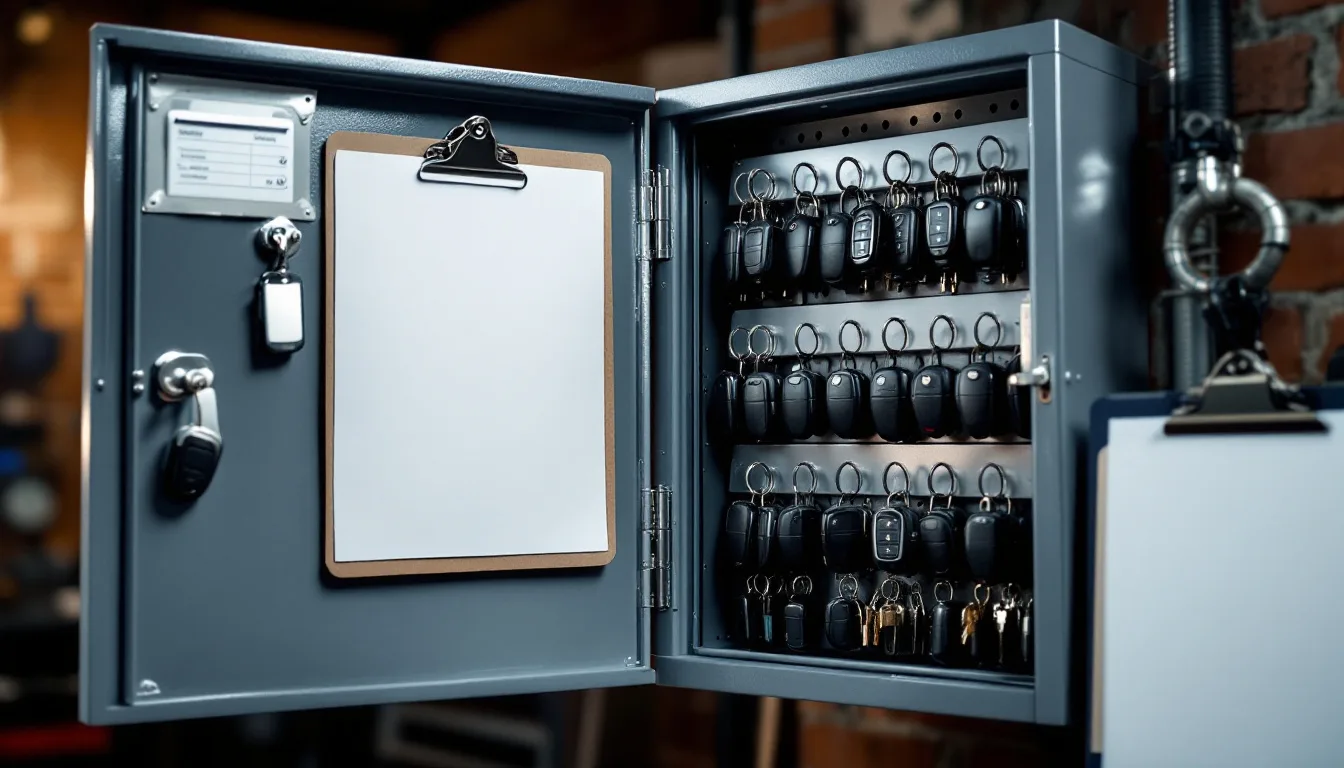
- Use a locking key cabinet with a sign-out sheet (or a $40 lockbox bolted in the office). The point isn't Fort Knox; it's knowing who had the key last.
- Record each vehicle's key data on the unit's file: VIN, key type (bladed transponder, remote-head, proximity fob), how many keys exist, and where each lives. Five minutes per vehicle, once.
- Quarterly verification: the office spare for every unit physically starts its vehicle. A spare that quietly died — battery, water, cracked board — is a spare you don't have.
Driver Turnover: The Key-Control Gap Nobody Budgets For
Vehicles outlast employees. Every departure — friendly or otherwise — raises the same question: what can that person still start?
For house keys and shop doors the answer is rekeying. For vehicles the answer is better: the immobilizer's key list is editable. A diagnostic tool reads how many keys each vehicle trusts, and an erase-and-re-enroll wipes the list and re-programs only the keys the company physically holds. Any key that walked away in a departed driver's pocket — or was copied, or vanished into a glovebox years ago — goes electronically dead. On bladed-key vehicles the old metal can still turn a door lock (rekeying cylinders closes that if the vehicle carries valuable tools), but it will never start the engine again.
A sane turnover procedure:
- Collect keys at exit interview and check the count against the unit file.
- If the count is short — or the exit wasn't friendly — schedule an erase-and-re-enroll for that unit. It's minutes per vehicle, and it's the same procedure trusted for stolen-key events.
- Audit high-turnover units annually regardless. Delivery and crew vehicles accumulate ghost keys; a key-count read is thirty seconds per van.
The security data behind these procedures moves through licensed, audited channels under the framework the National Automotive Service Task Force maintains (nastf.org), and professional locksmith standards require ownership verification on every job (aloa.org) — for a business that means company paperwork tying the vehicles to the entity, which we'll tell you to have ready before the visit. The Federal Trade Commission's small-business data-security guidance makes the general case that credential control is a process, not a purchase (ftc.gov); vehicle keys are credentials, and they deserve the same offboarding checklist as email accounts.
"The fleet call I dread is the Monday one: a crew lead quit, took the F-250's only key out of spite, and the trailer it tows is booked on a job site at eight. Erasing his key takes me ten minutes — but only if there's another key to re-enroll. When there isn't, that truck is down until an all-keys-lost job finishes. Two keys per unit isn't a locksmith upsell; it's the difference between a ten-minute fix and a lost day." — A licensed automotive locksmith on our Irving team
Bulk Programming Visits: How the Per-Vehicle Math Improves
The single most cost-effective thing a fleet owner can do is stop buying keys retail, one emergency at a time, and instead schedule one visit that touches every unit. One mobile trip to your yard in Irving or the Las Colinas business corridor, vehicles staged and idle (early morning or a slow Friday afternoon works), company paperwork ready — and the economics shift:
- The travel cost amortizes across the fleet. A mobile visit that services ten vans spreads the dispatch over ten units instead of one.
- Same-day scale. Spare programming runs 15–30 minutes per vehicle for most makes; a ten-van yard is a morning, not a month of one-off appointments.
- Mixed fleets are fine. Transits next to Silverados next to a Tacoma — the tooling covers domestic and Asian makes in one visit, and we flag any unit (typically some 2015+ models or brand-new model years) that needs dealer-only software so nothing surprises you. A tech confirms each unit's exact setup after the VIN list.
- The audit rides along free-ish. While connected for programming, reading the trusted-key count on every unit adds seconds. You end the day with a fleet-wide key census — the document most owners have never seen.
Per-key pricing follows the same honest bands as any vehicle, confirmed against each VIN: basic transponder keys $150–$275, smart/proximity fobs $300–$500 for domestic and Asian makes, $400–$700 for European vans and executive vehicles. Volume doesn't change physics, but it does eliminate repeated dispatch and emergency premiums — and it converts key spend from unpredictable emergencies into a scheduled line item. Our key fob programming service covers remotes and proximity fobs; the broader automotive locksmith services page covers everything else a fleet throws at us, from worn ignitions to lockouts.
The Downtime Math: What a Key Event Actually Costs
Owners consistently underprice key failures because they price the key and ignore the vehicle-day. Run your own numbers against this table — these use conservative DFW small-business figures as of July 2026:
| Cost Component | Prepared Fleet (2 keys + audit) | Unprepared Fleet (1 key, no policy) |
|---|---|---|
| Key event response | Swap to office spare — minutes | All-keys-lost job, hours to a day |
| Key cost when the event hits | $0 (spare exists) | Top of band + security labor; dealer path $500–$800/key + tow |
| Vehicle-day revenue lost | Usually $0 | $500–$1,500+ per crew-day (trade average) |
| Missed-job customer impact | None | Rescheduled or lost customer |
| Departed-driver exposure | Erase in minutes at next service | Unknown person can start the unit indefinitely |
| Annual key line item | Predictable, scheduled | Random, emergency-priced |
The asymmetry is the argument. A programmed spare costs $150–$500 once; a single crew-day lost to a key event can exceed that before lunch, and the insurance-research literature adds the tail risk — commercial vehicles and their contents are theft targets, and stolen work vehicles carry tool and cargo losses well beyond the vehicle itself (iihs.org). Two keys and a clean immobilizer list are the cheapest line items in your risk column.
Beyond Keys: Small-Fleet Extras Worth Knowing
- Ignition wear runs ahead of schedule on fleet vehicles. High daily key cycles wear wafers and springs; a unit whose key needs jiggling is telegraphing a future no-start. Fixing the cylinder on schedule beats a roadside failure — vehicle electrical and mechanical key-system durability is engineered to standards (sae.org), but fleet duty cycles find the limits early.
- Standardize where you can. When replacing units, matching makes/models means shared key blanks, shared procedures, and cheaper visits.
- Vans with cargo partitions and slam locks: aftermarket cargo-security hardware has its own key ecosystem; keep those keys in the same cabinet discipline as ignition keys.
- Document the recovery drill. One page in the office: locksmith number, unit key locations, VIN list. The day it's needed, the person finding it won't be you.
Frequently Asked Questions
How many keys should each fleet vehicle have?
At least two programmed keys per unit: one with the assigned driver, one secured and labeled at the office, verified quarterly by physically starting the vehicle. Two keys means any single loss is a swap instead of an all-keys-lost event, and it keeps every future key job in the cheap add-a-spare category rather than the expensive security-procedure category.
What should we do about vehicle keys when a driver quits?
Collect keys at exit and check the count against the unit's file. If any key is unaccounted for — or the departure was hostile — have the vehicle's immobilizer key list erased and re-enrolled with only the keys the company holds. The departed key then can't start the vehicle. On bladed-key units storing valuable tools, consider rekeying the door cylinders too, since a deleted key's metal can still turn a lock.
Can you program keys for multiple vehicles in one visit?
Yes — bulk visits are the whole point for fleets. Stage the vehicles at your yard, have company ownership paperwork and the VIN list ready, and most makes program at 15 to 30 minutes per unit. A ten-vehicle fleet is typically a single morning, the travel cost spreads across every unit, and we read each vehicle's trusted-key count while connected so you leave with a fleet-wide key census.
How much does fleet key programming cost in Irving TX?
As of July 2026, per-key pricing follows standard bands confirmed against each VIN: basic transponder keys $150–$275, smart or proximity fobs $300–$500 for domestic and Asian makes, and $400–$700 for European vehicles. A key-count audit with erase and re-enroll typically runs $120–$250 per vehicle and is cheapest bundled into a programming visit. Scheduled bulk work avoids the emergency premiums and repeat dispatch fees of one-off calls.
What happens if a fleet vehicle loses its only key?
It becomes an all-keys-lost job: the blade is cut by code from the VIN, the immobilizer runs its security procedure, and the price lands at the top of the band plus security labor — with the vehicle undrivable until it's done. Dealers quote $500–$800 per key on mainstream makes plus a tow and often multi-day scheduling. This is precisely the scenario the two-key policy exists to prevent.
Do newer fleet vans have programming restrictions?
Some. Certain 2015+ models and most brand-new model years gate key programming behind manufacturer software that hasn't reached the independent aftermarket, making the dealer temporarily the only path. When you send us your fleet's VIN list we flag those units up front, so the bulk visit covers everything that can be done mobile and nothing is a surprise.
Can old or unknown keys from before we bought a used van still start it?
Yes. The immobilizer trusts every key ever enrolled, and buying the vehicle doesn't clear the list — an auction van may trust keys held by people neither you nor the seller could name. Reading the key count takes seconds, and an erase-and-re-enroll makes the fleet's key reality match the office key cabinet. It's a standard part of onboarding any used unit.
Put Your Fleet's Keys Under Control This Month
One scheduled visit turns key chaos into a policy: two keys per unit, a verified office cabinet, a clean immobilizer list on every van, and a per-vehicle record you can hand the next office manager. Irving Locksmith Pros brings the programming and audit tooling to your yard across Irving, Las Colinas, Grand Prairie, and the surrounding DFW cities.
Call or text 817-842-1751, email contact@irvinglocksmithpros.com, or reach us through our contact page with your vehicle list — year, make, model, VIN — and we'll quote the whole fleet before we roll.
References
- National Highway Traffic Safety Administration — immobilizers and vehicle theft prevention: https://www.nhtsa.gov
- AAA — roadside assistance data and lockout guidance: https://www.aaa.com
- National Automotive Service Task Force — secure vehicle security-data access: https://www.nastf.org
- Associated Locksmiths of America (ALOA) — professional standards and verification: https://www.aloa.org
- Federal Trade Commission — small-business security and consumer guidance: https://www.ftc.gov
- Insurance Institute for Highway Safety — commercial vehicle theft and loss research: https://www.iihs.org
- SAE International — vehicle key and security system engineering standards: https://www.sae.org
Reviewed by a licensed automotive locksmith technician at Irving Locksmith Pros. Texas DPS Private Security regulated. Mobile service; ownership verification required.