Key Fob Programming Cost in Irving TX, Broken Down by Fob Type
2026 key fob programming cost in Irving TX by fob type — remote, remote-head, flip key, proximity smart fob and key card. Real prices and times.
Why One Price for Key Fob Programming Does Not Exist
Search for key fob programming in Irving and you will find quotes that range from under a hundred dollars to well over five hundred. Both can be honest. They are describing different pieces of hardware doing different jobs, and the word "fob" is doing far too much work in the middle of that sentence.
As of August 2026, Irving Locksmith Pros programs every fob type below on-site across Irving, Las Colinas, Grand Prairie, Euless, Coppell and the surrounding DFW cities. This guide exists so you can identify which fob you have before you call, and know within a reasonable band what you should expect to pay. Call or text 817-842-1751 with your year, make, model and VIN, and we will confirm the exact type in about a minute.
The core idea is simple. A car fob may contain up to three completely separate systems: a radio remote that operates the locks, a transponder that satisfies the immobilizer so the engine can start, and a proximity radio pair that lets the vehicle detect and authenticate the fob without you touching anything. Programming means something different for each one, and price tracks how many of those systems are present and how hard each is to enroll.
The Three Systems Hiding Inside a Fob
The remote. A one-way radio transmitter with a rolling code. Press lock, it transmits, the receiver in the vehicle accepts the code if it matches the expected sequence, the doors lock. Nothing about this touches the engine. If your remote stops working but the car still starts with the key, only this system has failed. Remote-only programming is the cheapest work in the category because the receiver's learn procedure is comparatively simple.
The transponder. A passive chip with no battery of its own. When it enters the field of the antenna ring around the ignition, the vehicle energizes it, the chip answers with an encrypted response, and the immobilizer decides whether to enable fuel and spark. This is the system that makes a hardware-store key copy turn in the door and never start the engine. NHTSA has documented the theft-reduction effect of immobilizers of this class for years, and IIHS loss data has repeatedly shown the gap between models with and without effective immobilizer coverage (nhtsa.gov, iihs.org).
The proximity pair. On push-button-start vehicles, low-frequency antennas around the car interrogate the fob continuously and the fob answers over a separate radio channel. The vehicle uses the timing and strength of that exchange to decide the fob is genuinely inside the cabin. Enrolling one of these means teaching the vehicle a new cryptographic partner, not just a code. That is why it is the most expensive of the three and the one where a lost last fob hurts most.
Once you know that, the price spread stops looking arbitrary. A remote is one simple system. A remote-head key is two systems in one plastic body. A proximity fob is the most complex of the three, plus a physically expensive part.
Fob Type by Fob Type
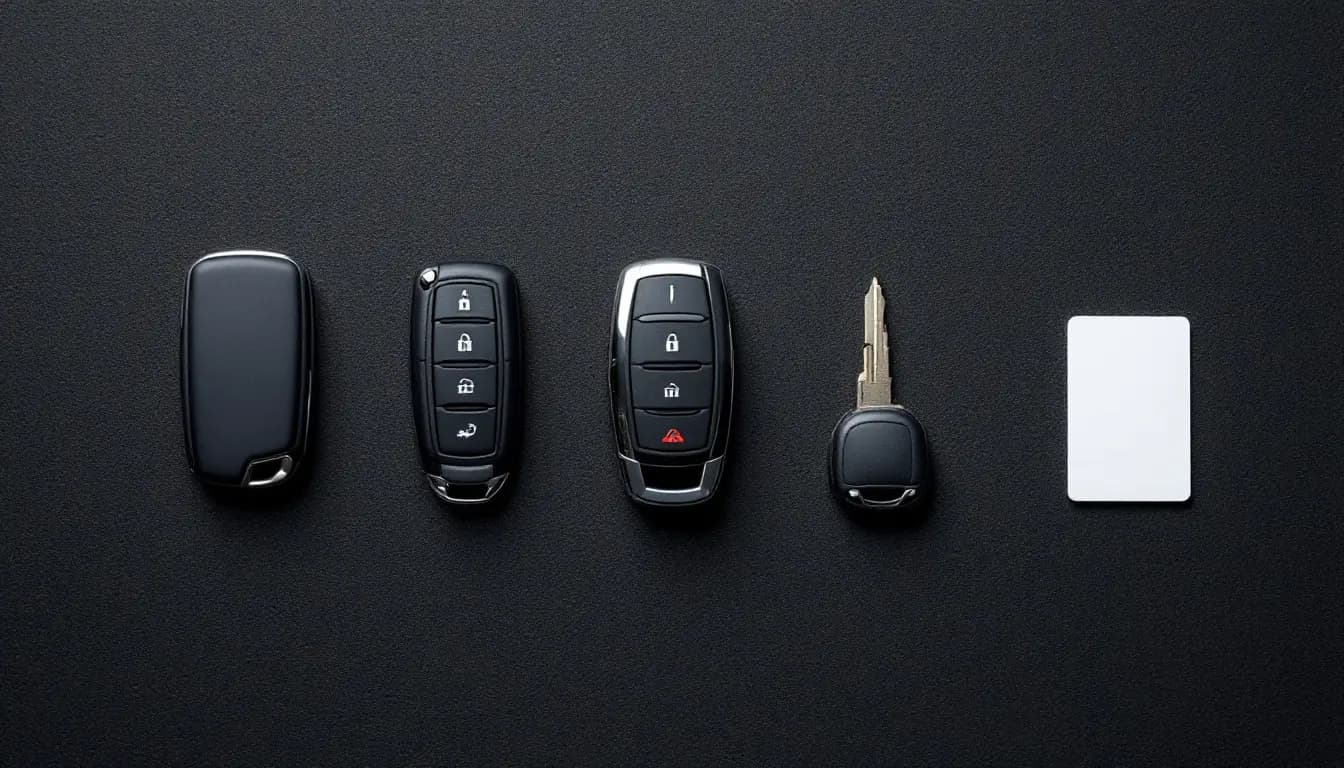
Basic remote / keyless entry fob
A small separate fob on your ring, buttons only, no metal blade and no chip. You still put a key in the ignition to start. Programming enrolls the remote's rolling code with the vehicle's receiver. Many vehicles of this era support an on-board learn sequence; others need a tool on the diagnostic port. Either way it is quick work, and if you supply your own compatible remote, cheaper still.
Common failure that is not a programming problem at all: a dead coin cell. Before paying anyone to program anything, change the battery. Our guide on how to change a car key fob battery covers it in a couple of minutes with a coin and a fingernail.
Remote-head key
One piece. Cut metal blade, transponder chip in the head, lock and unlock buttons in the same plastic. Two systems, two enrollments, and a blade that has to be cut correctly. This is where a lot of mid-2000s through mid-2010s vehicles live. The part costs more than a bare remote, and the labor is roughly double because both the immobilizer side and the receiver side need attention.
Flip key
Functionally a remote-head key with a folding blade that springs out of the housing. Same two systems inside, same programming work. The difference is mechanical: flip housings wear at the pivot and the spring, so an older flip key can fail physically while the electronics are fine. In some cases the chip and circuit board can move into a new housing, which is a cheaper repair than a whole new key. Ask before assuming you need a full replacement.
Proximity / smart fob
No blade in the ignition, because there is no ignition cylinder. The fob stays in your pocket, the vehicle detects it, you press a button. Inside is a proximity radio pair, a rolling-code remote and typically a hidden emergency blade for the driver's door. The part is expensive, the enrollment is the most involved, and the security model deliberately resists adding an unknown fob.
Two details that matter on this type. First, the hidden emergency blade on a replacement fob frequently ships uncut. If nobody cuts it, you cannot get into the car when the battery dies. We cut and test it every time. Second, loaded trims often tie extra functions to the fob — remote start, memory seat recall, hands-free liftgate — and those have to sync during programming or you will have a fob that starts the car and does nothing else you paid for.
If your push-button vehicle is throwing a no-fob-detected message rather than needing a new fob, that is a different problem with different causes. Our write-up on push-to-start not working and no fob detected walks through it.
Key card
A flat card rather than a fob, used by a handful of manufacturers. Electronically it behaves like a proximity credential and is priced in that neighborhood. Cards are thinner and more prone to physical damage from being carried in a wallet or sat on, and a cracked internal antenna trace usually cannot be repaired. Availability is narrower than mainstream fobs, so lead time can matter more than on a common model.
Irving Fob Programming Cost by Type, 2026
One table, everything in it. All ranges assume verified ownership, a standard-access vehicle, and a working key present unless the line says otherwise. Final price is confirmed against your VIN before work begins.
| Fob Type | What Is Inside | Typical Irving Cost | Typical Time On Site |
|---|---|---|---|
| Basic remote / keyless entry | Rolling-code radio remote only | Quoted on-site — our least expensive category | 10–20 minutes |
| Remote-head key | Cut blade + transponder + remote | $150–$275 | 20–35 minutes |
| Flip key | Folding blade + transponder + remote | $180–$275 | 20–40 minutes |
| Proximity / smart fob (domestic and Asian) | Proximity pair + remote + hidden blade | $300–$500 | 30–60 minutes |
| Proximity / smart fob (BMW, Mercedes, Audi, Porsche, JLR) | Encrypted proximity, brand-specific security | $400–$700 | 45–90 minutes |
| Key card | Proximity credential in card form | $300–$500 | 30–60 minutes |
| Any of the above, all keys lost | No trusted credential to enroll against | Add roughly $100–$200 to the band | 45 minutes–2 hours |
| Fob works, vehicle will not detect it | Diagnosis: antenna, receiver or module | Quoted after diagnosis | Varies |
The all-keys-lost row is the one people misjudge most. It is not a different key. It is the same key, plus the security procedure the vehicle enforces when nothing it trusts is present. On a transponder vehicle that commonly lands in the $250 to $400 range overall, and on a proximity vehicle in the $400 to $600 range, with European smart-key work reaching about $700. For the full cross-make picture including cutting and origination, see our breakdown of car key replacement cost in Irving TX.
"The question I wish more people asked on the phone is whether their fob has a metal blade in it. That one answer tells me most of what I need to know about the price, and it saves a customer from expecting a hundred-dollar job on a five-hundred-dollar fob." — a senior technician on our Irving crew
When Programming Is Not the Answer
A meaningful share of fob calls are not programming jobs, and a technician worth hiring will tell you so before taking your money.
Dead battery. The single most common cause of a fob that stopped working. A coin cell costs a few dollars. Try that first.
Water damage. A fob through the wash cycle or dropped in a pool sometimes revives after drying and sometimes does not. Corrosion on the board is usually terminal. There is no programming procedure that repairs a corroded trace.
Worn buttons or a cracked case. The rubber contacts flatten out over years. On some fobs the internals transplant into a fresh case cheaply, which beats buying a whole new programmed unit.
A receiver or module fault. If a known-good fob is not being seen, the problem may be the vehicle rather than the fob — a failed antenna, a receiver, or a body control module that is not processing the signal. That is diagnosis, not programming, and our coverage of BCM programming and replacement explains where that road goes.
A vehicle battery that just died or was replaced. Some vehicles need a relearn after a power interruption. That is a known behavior on a number of platforms and is not the fob's fault.
The Federal Trade Commission's advice on hiring a locksmith is directly relevant here: get a clear, itemized estimate before work begins, and be cautious about anyone whose price changes once they are standing next to your car (ftc.gov). AAA's roadside guidance likewise emphasizes confirming scope and price before authorizing service (aaa.com).
Aftermarket, OEM and Why the Part Matters
There is a real quality range in replacement fobs, and it shows up months later rather than on the day.
An original-equipment fob is made to the manufacturer's specification. A quality aftermarket equivalent from a reputable supplier is frequently fine and costs less. The cheapest listings on an auction site are a different category: mismatched chip types that will not enroll, weak transmitters with poor range, and cases that crack at the seam. Occasionally a bargain fob simply cannot be programmed at all, at which point you have paid for a part and a wasted appointment.
If you buy your own fob and ask a locksmith to program it, that is a legitimate way to save money, but understand the risk allocation. If the part cannot be enrolled, the labor was still spent. We are happy to work with a customer-supplied fob when the part is right, and we will tell you honestly on the phone whether the one you are looking at is likely to work.
The Society of Automotive Engineers maintains the standards environment that vehicle electrical and diagnostic interfaces are built around, which is part of why a properly specified aftermarket part can behave identically to an original while a random one cannot (sae.org). The Associated Locksmiths of America and the National Automotive Service Task Force cover the professional and security-data side of the same equation for technicians (aloa.org, nastf.org).
Everything described here falls under our key fob programming service, delivered mobile across Irving and the surrounding cities.
Frequently Asked Questions
How much does key fob programming cost in Irving TX?
As of August 2026 it depends entirely on the fob type. A basic remote is the least expensive category and is quoted on-site, a remote-head or flip key runs $150 to $275, a proximity smart fob for a domestic or Asian vehicle $300 to $500, and a European smart key $400 to $700. All-keys-lost situations add roughly $100 to $200 to those bands. Final price is confirmed against your VIN.
Why is a proximity fob so much more expensive than a plain remote?
A plain remote is one simple system: a rolling-code transmitter that operates the locks. A proximity fob contains a cryptographic radio pair the vehicle continuously authenticates, plus a remote, plus a hidden emergency blade. The part costs several times more and the enrollment is deliberately harder because that difficulty is what stops a stranger adding a fob to your car.
Can I just replace the fob battery instead of reprogramming?
Very often, yes. A dead coin cell is the most common reason a fob stops responding, and it costs a few dollars to fix yourself. If the fob works again after a fresh battery, no programming is needed at all. If it still does not respond with a known-good battery, then something else has failed and it is worth a call.
Do I need to bring the car somewhere to program a fob?
No. All of this is mobile work. We come to your home, office, apartment garage or wherever the vehicle is parked in Irving, Las Colinas, Grand Prairie, Euless and the surrounding cities. That matters most on all-keys-lost jobs, where the vehicle cannot be driven and the alternative would be a tow costing $150 to $300 on its own.
Can you program a fob I bought online?
Often yes, if the part is correctly specified for your vehicle. That is a legitimate way to reduce cost. The risk is on the part: a mismatched chip type or a low-quality clone sometimes cannot be enrolled at all, and the labor is still spent. Send us the listing details with your VIN before you buy and we will tell you whether it is likely to work.
My fob is fine but the car says no key detected. Is that a programming problem?
Usually not. If a known-good fob is not being seen by the vehicle, suspect the vehicle side — an antenna, a receiver, a body control module, or in some cases a vehicle battery event that requires a relearn. That is a diagnostic job rather than a programming job, and selling you a new fob would not fix it.
How long does fob programming take on-site?
A basic remote is usually ten to twenty minutes. A remote-head or flip key runs twenty to forty. A proximity smart fob is commonly thirty to sixty minutes, and a European smart key can run forty-five to ninety. All-keys-lost work takes longer than any of those because the vehicle enforces a security procedure before it will accept anything new.
One Call, the Right Fob, the Right Price
The fastest way to get an accurate number is to tell us what is in your hand. Does it have a metal blade? Does it have buttons? Do you push a button to start the car or turn a key? Those three answers plus your VIN get you a firm quote in a couple of minutes.
Irving Locksmith Pros brings 15+ years of automotive locksmith experience to your location, with the blanks, the cutting equipment and the programming tools on the van. Call or text 817-842-1751 or email contact@irvinglocksmithpros.com.
References
- National Highway Traffic Safety Administration — vehicle theft prevention and immobilizer technology: https://www.nhtsa.gov
- Insurance Institute for Highway Safety — anti-theft systems and vehicle theft loss data: https://www.iihs.org
- SAE International — automotive electrical and diagnostic interface standards: https://www.sae.org
- Associated Locksmiths of America (ALOA) — professional automotive locksmith standards: https://www.aloa.org
- National Automotive Service Task Force (NASTF) — secure vehicle security-data access: https://www.nastf.org
- Federal Trade Commission — hiring a locksmith and getting a clear estimate: https://www.ftc.gov
- AAA — roadside assistance and key replacement consumer guidance: https://www.aaa.com
Reviewed by a licensed automotive locksmith technician at Irving Locksmith Pros. Texas DPS Private Security regulated. Mobile service; ownership verification required.