Ram 1500 RF Hub Module Programming in Irving TX (2026 Guide)
2026 Ram 1500 RF hub programming in Irving TX. What the hub does, failed hub versus failed fob, used module realities, and honest cost ranges by platform.
Ram 1500 RF Hub Programming in Irving TX: What the Module Actually Does
When a Ram 1500 puts "No Key Detected" on the cluster with the fob sitting in the cupholder, most owners buy a fob. Sometimes that fixes it. Often it does not, because the part that failed was never the fob — it was the module listening for the fob. On the Ram platform that listener is the radio-frequency hub, and it is one of the most commonly misdiagnosed components on the truck.
As of July 2026, Irving Locksmith Pros diagnoses and programs Ram module work on-site across Irving, Las Colinas, Grand Prairie, Coppell, Farmers Branch, and the surrounding DFW cities. This guide explains what the hub does on 2013-2018 DS trucks and 2019-and-later DT trucks, how to separate a hub failure from a fob failure before spending money, why a used module off a donor truck still needs programming, and what the honest cost ranges look like.
Call or text 817-842-1751 and describe the exact dash message and what the truck does when you press start. Module work is quoted after VIN and module confirmation, but the symptom description narrows the range considerably before anyone drives out.
Quick Answer
Diagnosis comes first on every Ram module call, because the same symptom comes from a $10 fob battery or a several-hundred-dollar module. As of July 2026, a replacement Ram key or fob runs $150 to $275 for a bladed transponder style and $300 to $500 for a proximity smart key. RF hub, wireless ignition node, and body-module programming are quoted after VIN and module confirmation — the work ranges from a straightforward configuration to a full programming session against a donor part. A dealer route on the same job typically starts at $500 to $800 and adds a tow if the truck will not start.
Ram Module and Key Pricing in Irving (As of July 2026)
| Ram 1500 Scenario | Typical Price Range | Notes |
|---|---|---|
| Diagnosis - confirm hub, fob, battery, or wiring | Quoted on the call | Establishes which part actually failed |
| Fob battery or fob repair | Lowest-cost outcome | Always ruled out first |
| Bladed transponder or FOBIK-style key replacement | $150–$275 | Spare with a working key present |
| Proximity smart key replacement (DT push-button trucks) | $300–$500 | Loaded fobs run higher |
| All keys lost - bladed / FOBIK Ram | $250–$400 | Security procedure with no trusted key |
| All keys lost - proximity smart key Ram | $400–$600 | Longer sequence, higher fob cost |
| RF hub or wireless ignition node programming | Quoted after VIN and module confirmation | Configuration plus key re-enrollment |
| Used or donor module programming to your truck | Quoted after VIN and module confirmation | Part must be married to the VIN |
| Emergency lockout only, no key made | $75–$145 | Non-destructive door entry |
| Dealer comparison - module and key together | $500–$800+ | Plus $150–$300 tow if the truck will not start |
Module work does not price honestly as a flat rate, and any quote that does is either padded for the worst case or going to change in your driveway. What we commit to is a diagnosis with a real finding, then a firm number before any part goes in.
What the RF Hub Is and Where It Sits
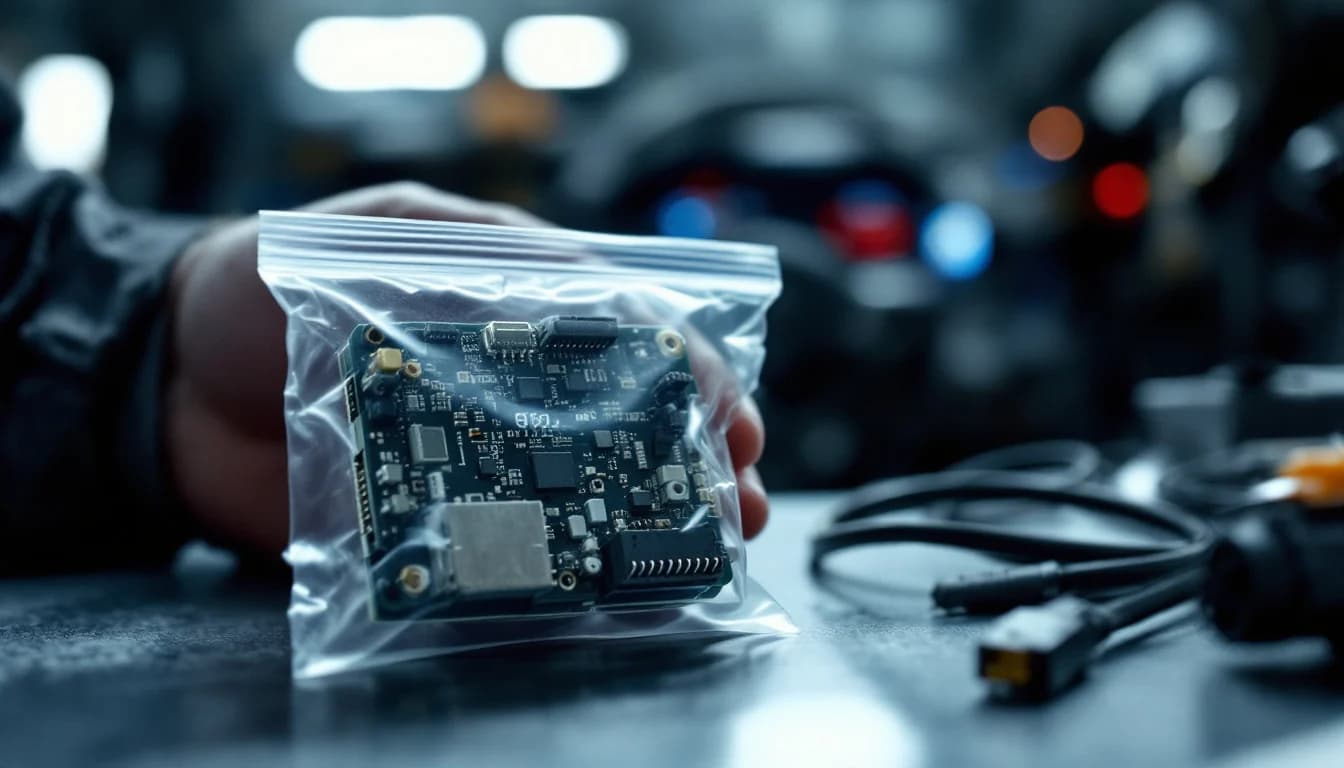
The radio-frequency hub is the module that owns the wireless conversation between your truck and the things that talk to it without wires — the key fob, the tire-pressure sensors, and on many trucks the remote start and passive entry functions. When you approach with the fob in your pocket and the door handle wakes up, the hub is what heard the fob. When you press the start button, the hub is a participant in confirming that an authorized key is present before the truck authorizes starting.
That last function is why a hub failure looks exactly like a key failure from the driver's seat. The truck is not saying "your key is bad." It is saying "I do not hear a key," and there are at least four reasons that sentence can be true.
2013-2018 DS trucks: the wireless ignition node era
Trucks in this window commonly use a FOBIK-style key that slots into a receiver and turns, with the wireless ignition node handling the ignition-switch function and the key-detection side together. Technicians still call this module the WIN, and it is a known wear item — it carries both an electrical role and a mechanical one, and mechanical parts wear.
A WIN-related failure often presents progressively: intermittent no-starts, a truck that starts on the second or third try, or accessory power that comes and goes. That progression is a useful diagnostic clue, because module electronics tend to fail more abruptly than mechanical assemblies do.
2019 and later DT trucks: the RF hub proper
The DT generation moved to push-button start across most of the range and separated the functions more cleanly, with the radio-frequency hub handling the wireless side and the body control module handling much of the rest. More modules on the network means more places for the conversation to break, but it also means better isolation — the diagnostic path is often clearer than on the older trucks because each module reports its own view. Vehicle network and electronic security architectures of this kind are described in open engineering standards work, which is what makes independent diagnosis possible at all (sae.org).
The full brand-level picture of how these modules interact across the Dodge, Ram, Jeep, and Chrysler family is in our guide to the WIN and RF hub on Dodge, Ram, Jeep, and Chrysler key fobs. Platform notes for the wider family live on the Dodge and Chrysler brand pages.
Failed Hub or Failed Fob? How We Tell the Difference
This is the whole job, and it is worth doing carefully because the two answers differ by several hundred dollars.
Test the second fob. If you have two and only one is ignored, the truck is listening fine. That is a fob problem, full stop. If both fobs are ignored, the truck is the suspect.
Test the backup start method. Ram push-button trucks have a documented procedure for starting with a dead fob battery, generally involving holding the fob against or very near the start button so the truck can read it at close range. If the backup works, the fob's battery or transmitter is weak and the hub is hearing at short range. That is a fob or battery fix.
Check the battery and charging system first. A weak 12-volt battery produces module behavior that mimics every failure on this list. A truck that has sat at DFW long-term parking for two weeks, or that has had a battery replaced without a proper relearn, can present with symptoms that look identical to a hub fault. Ruling this out costs nothing and it is skipped constantly.
Look at what else is broken. A hub or body-module fault rarely arrives alone. Remote start that stopped working, tire-pressure warnings with no tire problem, passive entry that quit, or interior lighting oddities alongside the key complaint all point at a module rather than a fob. A fob failure does not cause tire-pressure faults.
Read what the truck says. The diagnostic port carries the truck's own account of which module is not responding. That is the difference between diagnosis and guessing, and it is why we do not quote module replacement from a phone description alone.
For the symptom-side walkthrough of the dash message itself, see our no key detected and immobilizer service page.
"The Ram calls that go badly are the ones where somebody already bought two fobs online before anyone plugged into the truck. Two fobs and the same message is not bad luck. That is the truck telling you it is not the fob." — senior automotive locksmith technician, Irving Locksmith Pros
Used Versus New Modules, and Why Either One Needs Programming
Owners regularly ask why a used hub from a salvage truck costs almost as much installed as a new one. The answer is that the part is only half the price and the smaller half.
A modern module is not a generic component. It is married to a specific vehicle — configured against the VIN, carrying the security data for that truck's authorized key list, and expecting to talk to that truck's particular set of other modules. A donor module arrives married to somebody else's truck. Before it will work in yours, it has to be cleared of the previous relationship where that is possible, configured to your VIN, and have your keys enrolled into it.
Three practical consequences:
Some used modules cannot be reused at all. Depending on the module and how it was locked to the donor vehicle, the previous marriage may not be clearable through legitimate channels. Buying the part first and asking later is how people end up with an expensive paperweight.
New modules still require configuration. A factory-new part is blank, not pre-configured. It needs the VIN, the options set, and the keys. There is no plug-and-play path on a security-relevant module.
Key enrollment is a separate operation. After the module is configured, your keys have to be written into it, which is its own procedure with its own security gate. That is why a module job and a key job are quoted as two things even when they happen in one visit.
The framework under which independent technicians obtain the security data required for legitimate module and key work is maintained through NASTF, and it exists precisely because the alternative would make module swaps a theft technique (nastf.org). Professional standards in the trade reinforce the same boundary (aloa.org). Immobilizer and module security of this kind is credited across federal and insurance research with meaningful reductions in vehicle theft, which is why the process is deliberately gated (nhtsa.gov, iihs.org).
Our module repair and programming service covers the whole scope, and the neighboring case — when the body control module rather than the hub is the culprit — is detailed in our write-up on BCM programming and replacement.
Common Ram Symptoms and Their Usual Causes
"No Key Detected" with the fob in hand
Fob battery first, second fob second, backup start method third, then the truck. In that order, every time. The cheapest test goes first because it is also the most likely answer.
Truck cranks but will not run, security indicator lit
The engine is turning, so the starter circuit is fine. What failed is start authorization — the truck is not satisfied that an authorized key is present. That is immobilizer territory and it points at the key, the hub, or the security data relationship between modules.
Intermittent no-start that clears if you wait
Classic of both weak batteries and marginal modules, and genuinely hard to call without data. This is where the diagnostic port earns its keep — stored fault records survive the intermittency even when the symptom does not reproduce on demand.
Remote start and tire-pressure warnings appear together with a key complaint
Strongly suggests the hub, because those functions share the module. A fob cannot cause a tire-pressure fault.
It started acting up right after a battery replacement or a jump start
Very common and often benign. Modules can need a relearn or a reset after losing power. Worth checking before condemning anything expensive.
The Honest Boundary
Some Ram builds and some module functions sit behind software or security access the aftermarket does not have complete coverage of. When that is the case for your specific truck, the correct answer is that a technician confirms your exact setup against the VIN before we commit to the job — and if the function turns out to be dealer-only, we say so before dispatching rather than after arriving and charging for the trip.
We also will not quote a module replacement over the phone. Not because the number is a secret, but because the symptom you describe maps to at least four different repairs at four different prices, and only one of them is the module. Exact quote after VIN and module confirmation is not a hedge; it is the only responsible way to price this work. That principle is echoed in consumer guidance from the FTC and AAA, both of which advise getting a written estimate based on an actual inspection before authorizing vehicle work (ftc.gov, aaa.com).
Ownership Verification and How We Work
Texas regulates locksmith work through the Texas DPS Private Security Program, and module and key work requires proof you are entitled to the vehicle. We confirm photo identification matching the registration or title, ownership documentation showing your name against the VIN, and the 17-character VIN. For company trucks, that means business documentation and an authorized representative on site.
The visit runs in a fixed order: verification, diagnosis, finding, firm quote, approval, work, then function testing — start, lock, unlock, panic, passive entry, and remote start where equipped — before we leave.
We are mobile only, with no shop, working seven days a week from 7:00 AM to 9:00 PM with after-hours emergency dispatch for genuine emergencies. Coverage runs roughly 25 miles from an Irving base across Las Colinas, Grand Prairie, Coppell, Farmers Branch, Carrollton, Grapevine, Euless, Bedford, and out toward Arlington and Dallas. Typical response in the core area is 20 to 45 minutes.
Frequently Asked Questions
What does the RF hub do on a Ram 1500?
It is the module that handles the truck's wireless communication - key fob detection, tire-pressure sensor signals, and on equipped trucks passive entry and remote start. It participates in confirming that an authorized key is present before the truck authorizes starting, which is why a hub failure looks exactly like a key failure from the driver's seat.
How do I know if my hub failed or my fob failed?
Test a second fob, then try the documented backup start method for a dead fob battery, then check the 12-volt battery. If a second fob works, it is the fob. If the backup start works, it is the fob or its battery. If both fobs are ignored and other wireless functions like remote start or tire-pressure monitoring are also misbehaving, the hub becomes the primary suspect.
How much does Ram RF hub programming cost in Irving TX?
It is quoted after VIN and module confirmation, because the work ranges from a straightforward configuration to a full programming session against a donor part. For reference, key replacement on the same trucks runs $150 to $275 for a bladed transponder style and $300 to $500 for a proximity smart key as of July 2026. A dealer route on module work typically starts at $500 to $800 plus a tow if the truck will not start.
Can I buy a used module online and have you install it?
Sometimes, but ask before you buy. A used module arrives configured to the donor vehicle and has to be cleared, configured to your VIN, and have your keys enrolled. Depending on the module and how it was locked to the donor truck, that previous marriage may not be clearable through legitimate channels, in which case the part cannot be used at all.
Does a brand-new module work straight out of the box?
No. A factory-new module is blank rather than pre-configured. It still needs your VIN, your truck's option configuration, and your keys written into it before the truck will work normally. That programming is a separate operation from the physical installation and is priced separately.
My Ram started acting up right after a battery replacement. Is the hub bad?
Probably not. Modules commonly need a relearn or reset after losing power, and a weak or failing 12-volt battery produces symptoms that mimic module failure closely. This is one of the cheapest things to rule out and one of the most frequently skipped, so it is where the diagnosis starts.
Do you cover Ram trucks in Grand Prairie, Coppell, and Grapevine?
Yes. We run mobile service from an Irving base across roughly a 25-mile radius covering Las Colinas, Grand Prairie, Coppell, Farmers Branch, Carrollton, Grapevine, Euless, Bedford, and out toward Arlington and Dallas, seven days a week from 7:00 AM to 9:00 PM with after-hours emergency dispatch for genuine emergencies.
References
- National Automotive Service Task Force - secure vehicle security data access for independent technicians: https://www.nastf.org
- National Highway Traffic Safety Administration - vehicle theft prevention and immobilizer technology: https://www.nhtsa.gov
- Insurance Institute for Highway Safety - anti-theft technology and vehicle theft loss data: https://www.iihs.org
- Associated Locksmiths of America - professional standards for automotive locksmith and module work: https://www.aloa.org
- Federal Trade Commission - hiring a locksmith and insisting on written estimates: https://www.ftc.gov
- AAA - consumer guidance on vehicle electrical diagnosis and roadside service: https://www.aaa.com
- SAE International - automotive electronic security and vehicle network standards: https://www.sae.org
Get the Diagnosis Before You Buy the Module
If your Ram says it cannot find a key, the first thing worth buying is an answer, not a part. Irving Locksmith Pros brings the diagnostic tooling to the truck across Irving, Las Colinas, Grand Prairie, Coppell, Grapevine, and the surrounding DFW cities, seven days a week from 7:00 AM to 9:00 PM.
Call or text 817-842-1751 with your model year, the exact dash message, and what happens when you press start, or email contact@irvinglocksmithpros.com. You will get a range on the phone and a firm number on site — exact quote after VIN and module confirmation.
Reviewed by a licensed automotive locksmith technician at Irving Locksmith Pros. Texas DPS Private Security regulated. Mobile service; ownership verification required.