
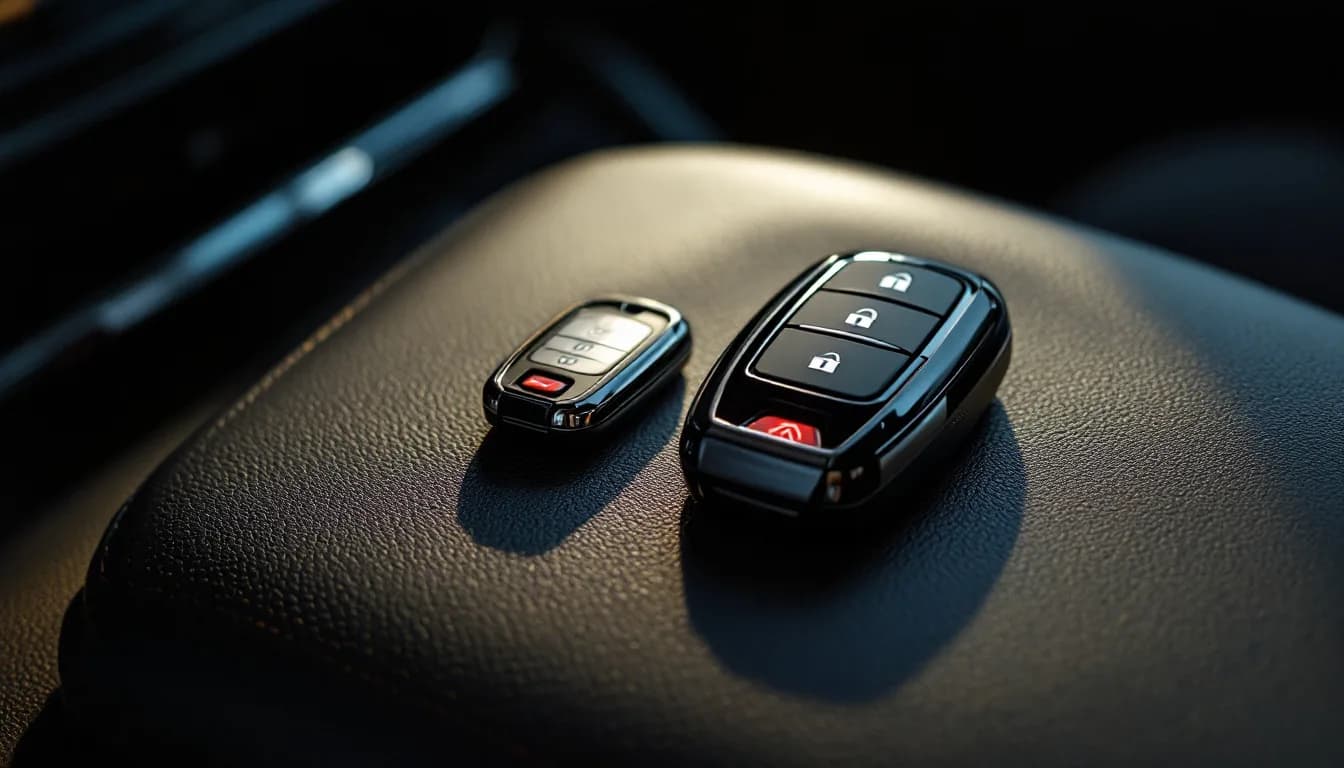
Valet Keys Explained Irving TX: Uses, Modes & Programming
2026 guide to valet keys in Irving TX. What they lock out, which cars have them, valet mode on push-to-start vehicles, and cutting or programming one.
The Valet Key, Explained: The Most Misunderstood Key on Your Ring
Somewhere in the paperwork pouch of many cars — often still taped to the owner's manual, never once used — is a slightly odd key. Maybe it's a plain metal blade with a gray plastic head where your main keys are black. Maybe it's a single blade with no remote buttons at all. That's the valet key, and most owners can't say what it does, whether it starts the car, or why the trunk ignores it. Then one afternoon the main key goes missing, somebody remembers the gray key in the glovebox... which is locked... with the gray key inside it. Now it's a locksmith story.
As of July 2026, Irving Locksmith Pros cuts, programs, and replaces valet keys across Irving, Las Colinas, Grand Prairie, and the surrounding DFW cities — and just as often we field the questions this little key generates: does it have a chip? Can it be my spare? What's the valet button in my push-to-start car actually doing? This guide answers all of it, including the honest economics of using a valet key as a budget emergency spare.
Questions about your specific car? Call or text 817-842-1751 with the year, make, and model — the VIN tells us exactly what your valet key can and can't do.
What a Valet Key Actually Is
A valet key is a deliberately limited key. It operates the driver's door and the ignition — so a parking attendant can park and retrieve your car — while refusing the places you'd stash valuables: classically the trunk and, on many models, the glovebox. Hand the attendant the valet key, lock your laptop in the trunk and your garage remote in the glovebox, and the car they can drive is also a car they can't rummage.
The mechanical trick is elegant and very old-school: the trunk and glovebox cylinders are keyed to respond only to the master key's full cut pattern, while the doors and ignition accept both master and valet cuts. On some designs the glovebox has a small lock the master key sets to "locked for valet" before you hand the car over.
On anything built in the transponder era — which is essentially everything since the early 2000s — the valet key also carries a chip, because the immobilizer won't authorize the engine without one. Immobilizers are the anti-theft layer federal regulators credit with collapsing hot-wire theft (nhtsa.gov), and they don't grant exceptions for gray plastic. This is the single most important fact in this article: a modern valet key is a programmed transponder key. It starts the car. It must be enrolled to the immobilizer like any other key. And that has two consequences people miss — it counts as a real key for security purposes, and it costs real key money to replace.
Which Cars Have Valet Keys — and What Replaced Them
The classic era. Luxury and near-luxury brands made valet keys standard equipment for decades — Lexus and Toyota, Honda and Acura, BMW, Mercedes-Benz, Cadillac, Lincoln, Infiniti, Jaguar. Many 1990s–2010s sedans and SUVs from these brands shipped with two black master keys and one gray-headed valet key. Sports cars and anything with a serious trunk followed suit. Trucks and base-trim economy cars often skipped it — no lockable partition worth protecting.
The transitional era. As remote-head keys and flip keys took over, the valet key often became the plain key in the set: the one blade with no buttons. Same limited access on some models; on others it became a full-access "service key" and the valet distinction quietly disappeared. This is where model-specific reality beats generalization — two same-year trims can differ.
The push-to-start era. Proximity fobs killed the separate valet key on most modern cars and replaced it with two things: the emergency blade hidden inside every smart fob (which opens the driver's door when the fob battery dies — and on some models, deliberately, only the driver's door), and valet mode in software. If your fob's blade seems weak or the fob is acting up, check the simple thing first — our guide to changing a car key fob battery covers the five-minute fix that solves most fob complaints.
Valet mode on modern cars does in software what the gray key did in brass: press a button sequence or a menu toggle (sometimes with a PIN), hand over the fob, and the car restricts itself — trunk release disabled, glovebox locked out, and on many models performance limited, speed capped, or the infotainment locked. Several performance brands log speed and location while valet mode is active. Tesla's valet mode caps power and speed and hides personal data; Corvettes famously record valet-mode video. The industry's design assumption, reflected across vehicle-security engineering practice, is that limited-privilege access is a feature drivers still want — the implementation just moved from metallurgy to firmware (sae.org).
The Valet Key as a Budget Emergency Spare
Here's the practical angle that makes this article worth your time. As of July 2026, a large share of the vehicles on Irving driveways are one-key cars — and a one-key car is one washing machine away from an all-keys-lost job priced at the top of every band. The gold-standard fix is a full spare (fob and all). But there's a budget version many owners don't know exists: a programmed valet-style plain transponder key.
The logic: what makes an all-keys-lost job expensive isn't the missing remote — it's the missing transponder. If any programmed key exists, a future key job stays in the cheap add-a-spare category, the car stays drivable, and a lockout stays a $75–$145 entry job instead of a stranding. A plain bladed transponder key — no buttons, no remote guts — is the cheapest object that satisfies "any programmed key exists." For many vehicles it runs $150–$275 cut and programmed, versus $300–$500 for a full smart/prox fob (and $400–$700 on European makes).
The honest limits of the budget spare:
- On true push-to-start cars, a blade-only key usually can't start the car — the system needs the proximity credential. There, the budget spare is a second fob or nothing; the emergency blade alone only opens the door. (Still valuable — a lockout ends with your own blade instead of a service call, a point AAA's perennial lockout statistics make for us (aaa.com).)
- A valet-cut blade may not open your trunk or glovebox — by design. For an emergency spare that's usually fine; know it going in.
- It counts as a key the immobilizer trusts, so store it like one — at home in a drawer, never inside the car. A magnetic box under the bumper hands a thief exactly what the immobilizer exists to deny them, and theft research keeps showing that key-present thefts are the modern thief's easiest path (iihs.org).
Our car key replacement service covers both versions — the full fob and the budget transponder spare — and we'll tell you plainly which your model supports.
"People apologize when they ask for 'just a cheap key that starts it.' No apology needed — that's often the smartest $200 in this trade. A plain programmed blade in a kitchen drawer means you'll never pay all-keys-lost pricing, never wait for a tow, and never meet me at midnight. The remote buttons are convenience; the chip is the insurance." — A licensed automotive locksmith on our Irving team
Cutting and Programming a Valet Key: What the Job Looks Like
Replacing or adding a valet key is the same discipline as any transponder work, with one wrinkle:
- Ownership verification first. Photo ID and registration or title matching the VIN — the professional standard that locksmith associations codify (aloa.org) and that Texas DPS Private Security regulation expects of licensed providers. A key that deliberately limits access is still a key that starts the car.
- Blank selection by VIN. The VIN determines the blade profile (edge-cut or high-security laser-cut — many Lexus and Honda valet keys are milled sidewinder blades) and the correct transponder generation.
- The cut. Duplicated from your master, or cut by code pulled through licensed channels when no key exists — the same secure-data framework that governs all key-code access (nastf.org). A true valet cut, where the model supports it, uses the valet bitting so the trunk/glovebox lockout works; a full-access cut is also an option if you just want a plain spare.
- Programming. The chip enrolls to the immobilizer through the OBD-II port — minutes with a working master present; the full all-keys-lost security procedure if not. If your set includes remotes, our key fob programming service handles those in the same visit.
- Testing. Doors, ignition, and — deliberately — the trunk and glovebox, to confirm the lockout behaves the way the model intends.
One honest caveat that applies across this trade: some 2015+ vehicles and brand-new model years gate key enrollment behind dealer-only software. A tech confirms your exact setup after the VIN, before you spend anything.
Valet Key Costs in Irving (2026 Bands)
| Scenario | Typical 2026 Range | Notes |
|---|---|---|
| Plain valet/transponder blade, duplicated + programmed (master present) | $150–$275 | The budget emergency spare |
| Valet key with high-security laser-cut blade (Lexus, Honda, Acura) | $175–$300 | Milled blade + chip enrollment |
| Valet key cut by code (no working key to copy) | Top of band + security labor | All-keys-lost procedure applies |
| Full smart/prox fob instead (domestic + Asian) | $300–$500 | The full-featured spare |
| European smart key (BMW, Mercedes, Audi, Jaguar) | $400–$700 | Proprietary electronics |
| Emergency blade for a smart fob (insert only) | $60–$150 | Cut to your door; no programming needed |
| Dealer comparison (valet or master key) | $500–$800 per key + wait | Plus tow if no working key exists |
Every line: final price confirmed against your VIN. And the standing consumer rule from the FTC applies to any key purchase — insist on an up-front, itemized quote before work begins (ftc.gov); "call for pricing" that becomes triple on arrival is the industry's oldest trick.
Valet Habits Worth Keeping (Even With Valet Mode)
- Hand over only the valet key or valet-moded fob — never the ring with your house keys, and never a fob with the home address programmed as a favorite destination.
- Lock the glovebox and trunk before the handoff on classic valet-key cars; that's the entire feature.
- Test your valet key twice a year. A valet key that's never verified is a spare you may not actually have — blades wear, chips of that era occasionally die, and finding out during an emergency defeats the purpose.
- Bought a used car with a valet key missing? The immobilizer may still trust it wherever it is. A key audit — reading the trusted-key count and erasing what you don't hold — takes minutes and closes that ghost-key gap.
Frequently Asked Questions
What is a valet key and what does it do?
A valet key is a limited-access key: it opens the driver's door and starts the car, but by design it won't open the trunk and, on many models, the locked glovebox. It exists so you can hand a parking attendant a key that drives the car without exposing your valuables. On modern vehicles it carries a transponder chip like any other key, so it's a fully programmed engine-starting credential — just with restricted mechanical access.
Does a valet key have a chip in it?
On virtually anything built since the early 2000s, yes. The immobilizer requires an enrolled transponder to authorize the engine, and valet keys are no exception — the gray head or plain blade look is cosmetic, but the chip inside is real and must be programmed to your car. That's also why replacing a lost valet key costs transponder-key money rather than hardware-store money.
Which cars come with valet keys?
Classically: Lexus, Toyota, Honda, Acura, BMW, Mercedes-Benz, Cadillac, Lincoln, Infiniti, Jaguar, and most luxury sedans and SUVs from the 1990s through the 2010s, typically as a gray-headed or buttonless third key. Modern push-to-start vehicles mostly replaced the separate valet key with a software valet mode plus the emergency blade hidden inside the smart fob. Your VIN and owner's manual settle what your specific model shipped with.
What is valet mode on a push-to-start car?
Valet mode is the software descendant of the valet key: a button sequence, menu toggle, or PIN that restricts the car before you hand over the fob. Depending on the model it disables the trunk release and glovebox, caps speed or power, locks the infotainment and personal data, and sometimes logs or records the drive. Check your owner's manual for the activation steps — and set the PIN before the first time you need it.
Can I use a valet key as my spare key?
Yes, and it's often the smartest budget move on non-push-to-start cars. A plain programmed transponder blade — around $150 to $275 in the Irving area as of July 2026 — keeps you out of all-keys-lost territory, gets you into a locked car, and starts the engine. Its limits: it may not open the trunk or glovebox, and on true push-to-start vehicles a blade alone can't start the car, so the spare there needs to be a second fob.
How much does it cost to replace a lost valet key in Irving TX?
With a working master key present, a duplicated and programmed valet-style key runs about $150 to $275, or $175 to $300 where the model uses a high-security laser-cut blade. If the valet key was your only key, all-keys-lost pricing applies — code-cut blade plus the security procedure, at the top of the band plus labor. Dealers typically charge $500 to $800 per key plus scheduling delays. Final price is confirmed against your VIN.
My car came with no valet key. Should I worry that one exists somewhere?
It's worth a five-minute check. The immobilizer keeps a list of every key it trusts; if the count exceeds the keys in your hand, a previous owner's valet key (or any other key) is still live. A locksmith can read the count and, if you want certainty, erase the list and re-enroll only your keys — after which any stray valet key is dead metal.
Get a Valet Key Cut, Programmed, or Replaced in Irving
Whether you want the classic gray key replaced for actual valet duty, a budget transponder spare that keeps you out of all-keys-lost pricing, or a read on how many keys your used car secretly trusts, Irving Locksmith Pros handles it at your driveway across Irving, Las Colinas, Grand Prairie, and the surrounding DFW cities — usually same-day.
Call or text 817-842-1751 or email contact@irvinglocksmithpros.com with your year, make, model, and VIN for an exact quote.
References
- National Highway Traffic Safety Administration — immobilizers and vehicle theft prevention: https://www.nhtsa.gov
- SAE International — vehicle locking and security system engineering practice: https://www.sae.org
- AAA — lockout statistics and roadside consumer guidance: https://www.aaa.com
- Insurance Institute for Highway Safety — vehicle theft research: https://www.iihs.org
- Associated Locksmiths of America (ALOA) — professional standards and verification: https://www.aloa.org
- National Automotive Service Task Force — secure key-code and security-data access: https://www.nastf.org
- Federal Trade Commission — locksmith consumer guidance and avoiding scams: https://www.ftc.gov
Reviewed by a licensed automotive locksmith technician at Irving Locksmith Pros. Texas DPS Private Security regulated. Mobile service; ownership verification required.