
Water-Damaged Key Fobs & Modules Irving TX: Repair Guide
2026 guide to water-damaged key fobs and flooded vehicle modules in Irving TX. Fob rescue steps, replacement costs, BCM corrosion, storm-season advice.
Water-Damaged Key Fobs and Flooded Modules in Irving TX: What Survives, What Doesn't
The two calls sound different but end up on the same workbench. The first: "My key fob went through the washing machine — the buttons don't work and now the car says no key detected." The second, usually a week or two after a North Texas gully-washer: "Ever since the water got in, the car locks itself randomly, the windows have a mind of their own, and sometimes it won't start." One is a $10 gasket failure or a $300 fob replacement. The other is water intrusion into a body control module, and it behaves like a slow electrical haunting.
As of July 2026, Irving Locksmith Pros handles both ends of that spectrum across Irving, Las Colinas, Grand Prairie, and the surrounding DFW cities — from rescuing a washed fob and programming its replacement, to diagnosing corrosion in the modules that decide whether your engine is allowed to start. This guide covers the realistic rescue steps for a wet fob, the honest point at which a fob is dead and needs replacement plus programming, what flood water actually does inside vehicle electronics, and why Texas storm season keeps this work steady.
If your fob is wet right now, skip ahead to the rescue steps — the first hour matters. Then call or text 817-842-1751 with your year, make, and model.
What's Inside a Key Fob, and What Water Does to It
A modern key fob is a small circuit board carrying a battery, a remote transmitter, a transponder chip, and — on proximity fobs — the passive antenna hardware that lets push-to-start systems find the key in your pocket. The transponder chip itself is remarkably tough: it's a passive component with no battery of its own, and it frequently survives a full wash cycle. What dies is everything around it.
Plain water is a conductor and a corrosive. The moment it bridges the battery terminals and the board, electrolysis begins etching the copper traces. Washing-machine water is worse — hot, soapy, and agitated for forty minutes. Pool water adds chlorine. A fob dropped in a lake or a storm drain picks up mineral-heavy water that leaves conductive residue as it dries. The failure pattern is predictable: buttons die first (their contact membranes trap moisture), then the remote transmitter drifts or falls silent, and finally corrosion reaches the battery clip or the crystal and the board goes dark.
Here's the part most drivers don't know: because the transponder is passive, a "dead" washed fob often still starts the car if you hold it directly against the start button or the steering column — many manufacturers build in exactly that backup position for a dead-battery fob. If that trick works, your immobilizer chip survived; you're shopping for a remote repair or shell-and-board replacement, not an all-keys-lost job. That distinction is worth hundreds of dollars.
Fob Rescue: The First Hour
If the fob just got wet, the order of operations matters more than the products involved:
- Get the battery out immediately. Pop the case (there's usually a slot for a coin near the keyring loop) and remove the coin cell. Corrosion needs power to accelerate; cutting it buys you time.
- Rinse only if the water was dirty. Soap, chlorine, or muddy storm water leaves residue that keeps conducting after it dries. A brief rinse of the board with clean distilled water — board only, battery out — beats letting soap dry in place. It feels wrong; it's right.
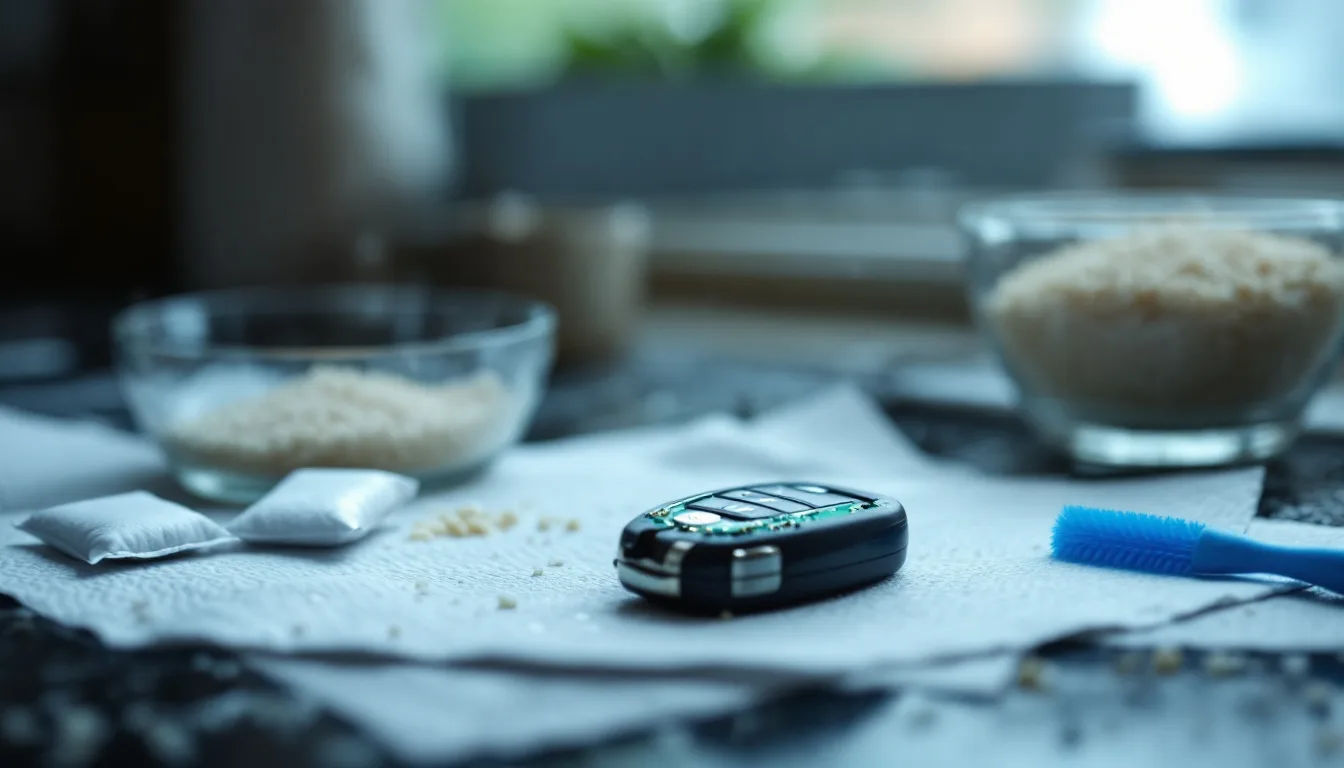
- Dry it properly. Pat the board, then let it air-dry 24 to 48 hours in a warm, dry spot with the case open. A fan helps. Skip the rice myth — rice mostly absorbs your patience. Isopropyl alcohol (90%+) on a soft brush displaces water and cleans early corrosion off contacts.
- Do not use direct heat. Hair dryers on high, ovens, and dashboards in a Texas July can warp the case and cook the board. Warm airflow, not heat.
- Reassemble with a fresh battery and test everything — every button, and range. A fob that works at arm's length but not across the parking lot has a drifting transmitter, and it will strand you at the worst time.
If buttons stay dead or range never comes back, the board is compromised. Corrosion is progressive — a fob that half-works this month is usually fully dead within a few, and consumer guidance from AAA has long noted that remote and key trouble tends to telegraph itself before it strands the driver (aaa.com).
When the Fob Is Dead: Replacement and Programming
A dead fob isn't just a parts purchase, because the replacement has to be married to your car twice: the remote functions enroll with the receiver, and the transponder enrolls with the immobilizer. Immobilizers are the anti-theft layer federal regulators have credited with major reductions in vehicle theft (nhtsa.gov), and they are precisely why a fob off the internet is not plug-and-play. Some brands also lock fobs to the first vehicle they're programmed to — a used eBay fob for many late-model vehicles can be unprogrammable, a fact professional locksmith associations regularly warn consumers about (aloa.org).
The economics as of July 2026 in the Irving area: a straightforward replacement remote-head key or basic fob with programming typically lands at $150–$275; a smart/proximity fob for domestic and Asian brands runs $300–$500; European smart keys (BMW, Mercedes-Benz, Audi and similar) run $400–$700. If the washed fob was your only key, the job becomes all-keys-lost — the higher end of the band plus security/relearn labor — which is the single best argument for getting a spare made while your surviving key still works. Our key fob programming service covers all of these on-site.
One honest carve-out: if the fob still starts the car in the backup position, ask about a board-level option first. Sometimes a new shell, buttons, and battery clip on a surviving board — or moving your programmed board into a new case — beats full replacement.
Flood Cars: When the Water Gets Into the Modules
A wet fob is annoying. A wet car is a different animal. DFW storm season delivers flash floods that put water into parking garages, low crossings, and apartment-complex lots — and modern vehicles keep critical electronics in places floodwater loves. The body control module (BCM) frequently lives under the dash near a kick panel or under a seat; BMW's equivalent FEM/BDC modules sit low in the footwell; fuse boxes and connector runs snake along the floor pan. Federal environmental and emergency guidance is blunt that even a few inches of moving water is enough to flood a vehicle's interior (epa.gov), and post-hurricane consumer alerts from the FTC warn that flood-damaged vehicles routinely re-enter the used market with the damage concealed (ftc.gov).
What makes flood-module damage insidious is the delay. The car often works the day after it dries out. Then, over weeks, corrosion creeps across connector pins and board traces, and the symptoms start:
- Phantom electrical behavior — locks cycling on their own, windows or wipers self-activating, interior lights flickering, warning lights rotating through the cluster.
- Intermittent no-start or "no key detected" — the immobilizer conversation between the fob, the antenna ring, and the BCM/immobilizer module fails sporadically, then permanently. If your dash is showing that message now, our no key detected and immobilizer service is the right entry point.
- Battery drains — a corroded module that never fully sleeps pulls current all night.
- Communication faults — scan tools showing multiple modules offline on the network bus, a classic fingerprint of a corroded connector or a dying node. Vehicle network architectures and their failure modes are well-documented territory in SAE's standards work on in-vehicle communications (sae.org).
"Flood modules lie to you. The car starts fine for two weeks, then one morning it's dead in the garage and the scan tool shows half the network missing. By the time the symptoms show up, the corrosion has been working since the day the water got in — which is why we tell people: if the water line reached the carpet, get the modules inspected now, not after the no-start." — A licensed automotive locksmith on our Irving team
Repair, Reprogram, or Replace: How Module Decisions Get Made
Not every wet module is dead, and not every dead module needs a dealership. The decision tree we walk with Irving customers:
Clean, dry, and test. A module that took light moisture without sustained power may recover after professional cleaning of the board and connectors. This is inspection-priced work — an honest range quoted after we see the module and pull codes against your VIN.
Repair at board level. Corroded pins, damaged traces, and failed grounds are sometimes repairable, particularly on older modules where replacements are scarce.
Replace and program. When the board is gone, a replacement module — new or donor — must be programmed: VIN-coded, immobilizer-synced, and configured to your vehicle's options. This is the step people miss when they buy a used BCM online; an unmarried module immobilizes the car just as thoroughly as a lost key. Our module repair and programming service handles the coding, the immobilizer alignment, and the relearn procedures.
Because flood damage varies so wildly, module work is quoted as an honest range with the exact number confirmed after VIN and module inspection. Anyone quoting a flat flood-repair price sight-unseen is guessing with your money. And a candid limit: some 2015+ modules and brand-new model years tie replacement to dealer-only software — a tech confirms your exact setup after the VIN, and we tell you before anything is ordered.
Storm Season Playbook for Irving Drivers
The theft-and-damage data crowd tracks hail and flood claims for a reason — North Texas sits in one of the country's most active severe-weather corridors, and insurers' research arms have documented for years how concentrated storm losses are in this region (iihs.org). A short checklist that saves real money:
- Don't crank a car that took water past the carpet line. Powering soaked modules accelerates the damage and can turn recoverable electronics into scrap.
- Photograph the water line inside and out before anything dries — it anchors your insurance claim.
- Get a second programmed key before storm season, stored somewhere that is not the same pocket, bag, or vehicle as the first.
- Buying used after a storm year? Check the title and history for flood brands and have the low-mounted modules inspected. FTC guidance after major flood events exists precisely because washed titles travel across state lines (ftc.gov).
Water-Damage Cost Bands in Irving (2026)
| Scenario | Typical 2026 Range | Notes |
|---|---|---|
| Fob battery, contacts, and clean-up after light water exposure | $20–$75 | Worth trying first if the board survived |
| Replacement basic transponder / remote-head key, programmed | $150–$275 | Washed fob dead, working spare exists |
| Smart/prox fob replacement, programmed (domestic + Asian) | $300–$500 | Includes proximity enrollment |
| European smart key replacement (BMW, Mercedes, Audi) | $400–$700 | Proprietary electronics |
| All keys lost (only key destroyed in wash/flood) | Upper end of band + relearn labor | Security procedure required |
| Module cleaning / inspection after water intrusion | Honest range quoted on inspection | Exact quote after VIN/module inspection |
| Module replacement with programming | Varies by module and brand | Some 2015+ modules are dealer-only |
Final price on every line is confirmed against your VIN.
Frequently Asked Questions
My key fob went through the washing machine. Is it ruined?
Not necessarily. Pull the battery immediately, rinse the board with distilled water if the wash water was soapy, dry it 24 to 48 hours with the case open, then test with a fresh battery. The transponder chip is passive and often survives — if the car starts with the fob held against the start button or column, the immobilizer chip is alive even if buttons and range are dead, and you may only need a remote repair or board swap instead of a full key.
Will rice fix a wet key fob?
Rice is mostly a myth. It absorbs ambient moisture slowly and does nothing about soap residue or corrosion already forming on the board. Removing the battery, rinsing dirty water off with distilled water, cleaning contacts with 90%+ isopropyl alcohol, and air-drying with the case open outperforms the rice bag every time.
How much does it cost to replace a water-damaged key fob in Irving TX?
As of July 2026: a basic transponder or remote-head key replacement with programming runs $150 to $275, a smart or proximity fob $300 to $500 for domestic and Asian brands, and $400 to $700 for European smart keys. If the destroyed fob was your only key, all-keys-lost security procedures push the job to the top of the band plus relearn labor. Final price is confirmed against your VIN.
Can a used or eBay fob be programmed to my car?
Often not. Many late-model vehicles lock a fob to the first car it was programmed to, making second-hand fobs unprogrammable, and aftermarket clones vary wildly in quality. We source fobs that will actually enroll on your specific year and trim, and the quote includes both the part and the programming so there's no surprise.
What does flood water do to a car's control modules?
Flood water starts corrosion on connector pins and circuit traces that progresses for weeks after the car dries. Typical results: phantom locking and window behavior, intermittent no-start or no-key-detected messages, battery drains from modules that never sleep, and network communication faults. Modules mounted low — the BCM under the dash or seats, footwell modules, floor-run connectors — are the usual casualties.
The car ran fine after the flood, but now it won't start. Why?
That delay is the classic flood-damage signature. Corrosion is progressive: the circuits worked while the damage was still shallow, then a critical trace or pin finally failed. If the immobilizer chain is affected you'll often see a security or key warning. Diagnosis means pulling codes, checking the network bus, and inspecting the low-mounted modules — an exact quote follows VIN and module inspection.
Should I buy a car with a flood-branded title?
Be very careful. Flood titles exist because water damage keeps surfacing for months after the event, and federal consumer alerts warn that some flood cars are retitled across state lines to hide the brand. If you're considering one, budget for module inspection up front and assume electronics repairs are a when, not an if.
Wet Fob or Flooded Car in Irving? Start Here
Whether it's one soggy fob or a car that hasn't been right since the water came up, Irving Locksmith Pros brings diagnosis, key programming, and module-level work to your driveway across Irving, Las Colinas, Grand Prairie, and the surrounding DFW cities — usually same-day.
Call or text 817-842-1751 or email contact@irvinglocksmithpros.com with your year, make, model, and what got wet. We'll tell you honestly whether it's a rescue, a replacement, or a module job.
References
- National Highway Traffic Safety Administration — vehicle theft prevention and immobilizer systems: https://www.nhtsa.gov
- AAA — roadside assistance and key/remote consumer guidance: https://www.aaa.com
- Associated Locksmiths of America (ALOA) — professional automotive locksmith standards: https://www.aloa.org
- Federal Trade Commission — flood-damaged car warnings and locksmith consumer guidance: https://www.ftc.gov
- Environmental Protection Agency — flood water hazards and emergency guidance: https://www.epa.gov
- Insurance Institute for Highway Safety — storm loss and vehicle damage research: https://www.iihs.org
- SAE International — in-vehicle network and electrical system standards: https://www.sae.org
Reviewed by a licensed automotive locksmith technician at Irving Locksmith Pros. Texas DPS Private Security regulated. Mobile service; ownership verification required.