Nissan Murano & Maxima Ignition Repair in Irving TX
2026 Nissan Murano and Maxima ignition repair in Irving TX. Worn cylinders, key will not turn, and the ESCL steering lock failure that causes a no-crank.
Two Very Different Cars Wearing the Same Badge
A Nissan Murano and a Nissan Maxima can arrive at the same complaint from opposite directions, and that is the single most useful thing to understand before anybody quotes you a price. One generation of these cars uses a physical bladed key turning a mechanical cylinder. The next generation uses a proximity Intelligent Key, a push-button start, and an electronically controlled column lock that has no cylinder to wear out at all.
When an owner calls and says "my Nissan ignition is broken," the first question is never the model year. It is whether the car starts with a key you twist or a button you press. Those two answers lead to completely different parts, completely different labor, and completely different bills.
As of August 2026, Irving Locksmith Pros performs mobile Nissan ignition and steering-lock diagnosis across Irving, Las Colinas, Grand Prairie, Coppell, Farmers Branch, and the surrounding DFW cities. This guide walks the symptom through to the repair path in the order a technician actually works it, because on these cars diagnosing before ordering parts is the difference between a modest repair and a wasted several hundred dollars.
Call or text 817-842-1751 and describe exactly what the car does. What it does is the diagnosis.
The Free Checks, Before Anyone Touches the Column
Run these first. They cost nothing, they take four minutes, and collectively they close out a meaningful share of "broken ignition" calls on bladed-key Muranos and Maximas.
Unload the steering wheel. If you parked with the front wheels turned, or nose-in on a sloped Irving driveway, the mechanical steering lock pin can end up carrying real load against the column. That load holds the mechanism and no amount of forcing the key will free it. Put steady rotational pressure on the wheel in one direction, hold it, and turn the key gently at the same moment. If nothing gives, try the other direction. Never yank on either one.
Confirm the shifter is fully in Park. All the way in, not close. Vehicles interlock the ignition against transmission position deliberately, and the federal motor vehicle safety framework that drives rollaway prevention and key-locking behavior is maintained publicly by the National Highway Traffic Safety Administration (nhtsa.gov). A shifter a few millimeters short of the detent produces exactly this symptom.
Compare your key to a spare. Hold them side by side under good light. If your daily key's cuts look rounder, softer, and shallower than the spare's, the ignition is probably fine and the key is worn past the point where it can lift the wafers correctly. This is the most misdiagnosed cause on any high-mileage Nissan.
Take everything off the keyring. A heavy ring hanging from the cylinder applies downward force every mile the car is driven. Over a decade that accelerates wear, and in the moment it can be enough to prevent alignment. Try the bare key alone.
If you drive a push-button Murano or Maxima, none of the above applies in the same way, and you should skip ahead to the steering-lock section. Your car has no cylinder to bind.
What "Ignition" Actually Means on These Cars
The word covers four separate assemblies. Knowing which one failed is the whole job.
The lock cylinder is the mechanical piece your bladed key enters. Spring-loaded wafers inside ride against the cuts on the blade. When every wafer sits at the correct height the cylinder rotates freely. When wafers and springs wear, they stop aligning and the cylinder binds, drags, or refuses entirely.
The ignition switch is the electrical half behind the cylinder. It is what tells the car to power accessories, run, and crank. A cylinder can turn perfectly while the switch fails to deliver, and that produces a distinct signature: the key rotates normally through every position and absolutely nothing happens.
The immobilizer antenna ring encircles the cylinder and reads the transponder chip in the head of your key. When it fails, the key turns, the engine cranks, and the car will not run, because the security system never confirmed a valid key was present.
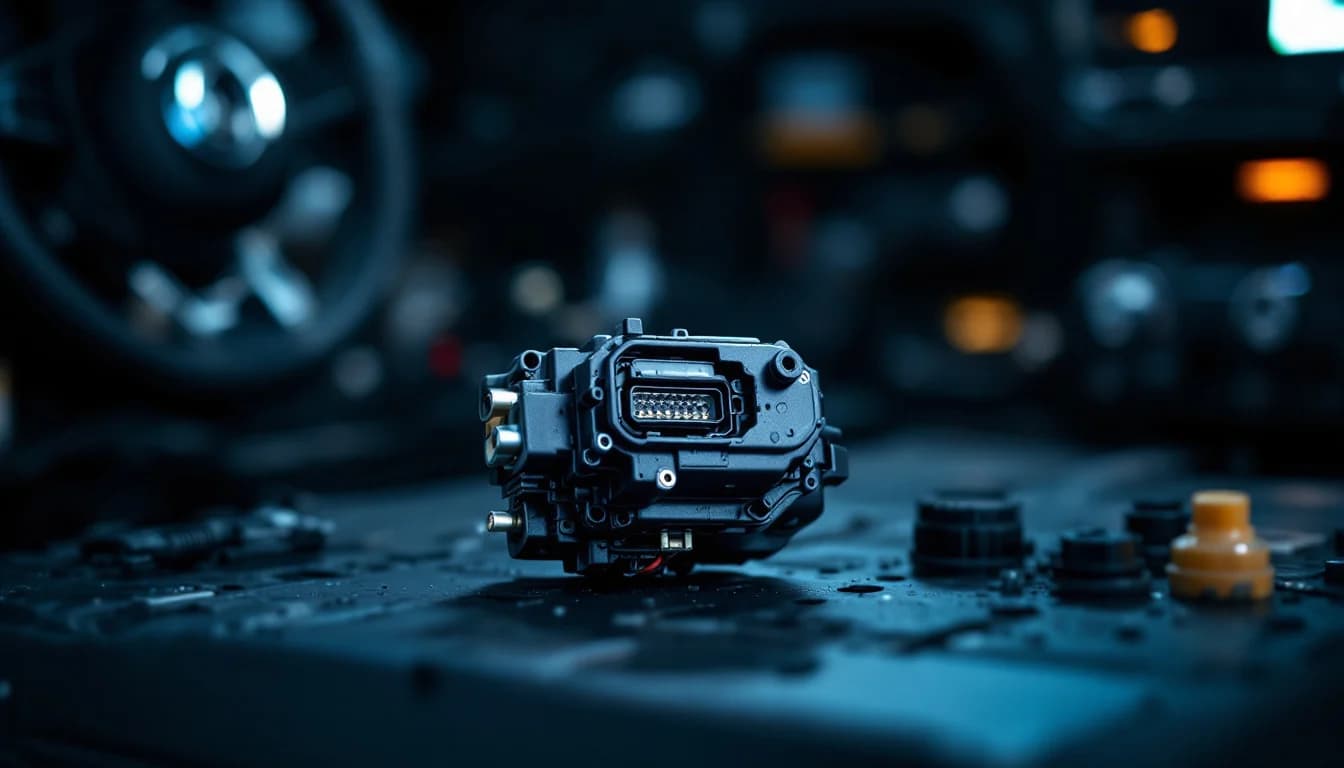
The electronic steering column lock, usually written ESCL or sometimes ESL, is the one people do not expect. On push-button Nissans there is a small motorized actuator that physically extends and retracts a pin into the steering column. When you press the start button, the car must retract that pin before it will crank. If the actuator, its motor, or its control circuit fails, the car refuses to crank, throws a steering lock warning, and frequently leaves the wheel locked solid.
Four parts, four signatures. A shop that replaces a cylinder for every complaint will be wrong a great deal of the time on this lineup.
The Bladed-Key Murano and Maxima: Ordinary Cylinder Wear
Earlier Muranos and Maximas are conventional. A physical key, a turn cylinder, a mechanical steering lock, a transponder ring. These cars fail the way every bladed-key car fails: slowly, then all at once.
The pattern is recognizable. First the key needs a little jiggle. Then it needs a jiggle and a specific angle. Then it works only when you lift slightly and rotate. Then one Tuesday morning it does not work at all. That progression is wafer and spring wear inside the cylinder, and it is entirely mechanical.
The good news is that a bound or dragging cylinder on these platforms is frequently repairable rather than replaceable. A technician can extract it, open it, replace the worn wafers and springs, service the housing, and reinstall it with your existing key still operating everything. That matters for a practical reason: if you install a fresh cylinder and simply key it to whatever blank it shipped with, you now carry one key for the ignition and a different key for the doors. Owners hate that arrangement within a week. Keying the replacement to your current key preserves a single-key car, which is how it left the factory.
The Associated Locksmiths of America publishes the professional standards covering this kind of mechanical lock service and the ethics that surround it (aloa.org). Replacement genuinely wins when the housing is cracked, the face is damaged from a forced-entry attempt, or wear has gone past what new wafers will correct. A technician with the cylinder open can tell you which situation you are in, and you should expect that conversation before any part is ordered.
The Big One: ESCL Failure on Push-Button Nissans
This is the failure that strands people, and it is the reason this guide exists.
Later Muranos and Maximas start with a button. There is no ignition cylinder. Instead, an electronic steering column lock actuator sits on the column, and its entire job is to drive a pin into the steering shaft when you shut the car down and pull it back out when you start up. The car will not crank until the body electronics confirm that pin has retracted.
When the actuator fails, the sequence stops there. You press the brake, you press the start button, the dash lights up normally, and the engine never turns over. Very often a message appears reading along the lines of "steering lock" or "steering lock malfunction," and very often the wheel is locked solid so you cannot even roll the car onto a flatbed without the wheels pointed where they were.
Here is what makes this expensive to misdiagnose: the symptom looks like a dead key. Owners buy a fob battery, then buy a fob, then have the fob programmed, and none of it changes anything, because the fob was never the problem. The security system happily recognized the key. The car simply refused to release its own steering column.
Our Nissan brand page covers the lineup more broadly, and the ignition repair service page explains our general approach. If your car is showing a steering lock warning right now, the dedicated write-up on Nissan steering lock ESCL failure and the electronic steering column lock no-start goes deeper into that specific fault than this page has room for.
Telling an ESCL Fault Apart From a Dead Key or a Failed BCM
Three different causes produce a car that will not start. They are separable without guessing.
A dead or unrecognized Intelligent Key usually announces itself. The dash typically shows a key-not-detected or no-key symbol, and the manufacturer-designed backup works: hold the fob physically against the start button and press, which lets the car read the transponder directly at close range rather than over the air. If that gets the car started, your fob battery or fob is the issue and the steering lock is fine. That is key work, not module work.
An ESCL actuator failure shows a steering-related message rather than a key message, and the wheel is normally locked. The car acknowledges the key. It just will not crank. Pressing the fob against the button does not help, because the key was never the obstacle.
A body control module fault is the third possibility and the one that requires real diagnosis rather than a symptom chart. The body electronics arbitrate the whole conversation between the key, the start button, the steering lock, and the engine. When that arbitration breaks down, the car can present with a steering lock message even though the actuator itself is healthy, or present with intermittent no-starts that come and go with temperature. This is exactly the boundary where a technician has to read live data and communication rather than read a warning light. The related guide on Nissan and Infiniti Intelligent Key replacement and BCM issues covers that side of the system.
"The steering lock jobs are the ones that hurt people financially, because by the time they call us they have already bought a fob and paid somebody to program it. The car never had a key problem. It had a motor on the column that quit. I always ask what the dash said before anything else." — a senior automotive locksmith on the Irving Locksmith Pros team
Symptom to Repair Path
Irving-area mobile pricing as of August 2026. Ranges assume normal access. Anything requiring column disassembly beyond routine service, or any module-side work, is quoted after inspection rather than guessed at over the phone.
| What the Car Does | Most Likely Cause | Repair Path | Typical Range |
|---|---|---|---|
| Bladed key will not turn, wheel was turned when parked | Mechanical steering lock loaded against column | Free the column, verify nothing is damaged | Diagnostic visit only |
| Bladed key turns hard and inconsistently, high mileage | Worn cylinder wafers and springs | Cylinder service, rekeyed to your existing key | Quoted on-site after inspection |
| Your key looks rounder than the spare | Worn key, cylinder likely healthy | New key cut to factory code plus enrollment | $150–$275 |
| Key snapped off inside the cylinder | Fatigued blade | Non-destructive extraction, cylinder inspection | $75–$145 |
| Key turns fully, nothing electrical happens | Ignition switch, not the cylinder | Switch replacement, part varies by year | Quoted after diagnosis |
| Cranks but will not run, security light on | Immobilizer antenna or key transponder | Verify antenna, re-enroll or replace key | $150–$275 key portion |
| Push-button car shows key-not-detected symbol | Fob battery or failing Intelligent Key | Hold fob to start button, then battery or new fob | $300–$500 fob |
| Push-button car shows steering lock message, no crank | ESCL actuator or its control circuit | Diagnose before any part is ordered | Quoted after VIN and module confirmation |
| Intermittent no-start, message varies by day | Body control module or communication fault | Live data diagnosis, module-side repair path | Quoted after VIN and module confirmation |
The two rows near the bottom are the ones people misread as key problems. Reading the dash message correctly before you spend anything is worth more than any part on this table.
Why an ESCL Repair Is a Module Job, Not a Key Job
This distinction has real consequences for who you call and what you should expect.
A key job is a key job. Cut a blade, enroll a transponder, register a proximity fob, done. The vehicle's own security system accepts a new credential and everything else stays as it was.
A steering column lock repair is different in kind. The actuator is a powered mechanical device under the control of the vehicle's electronics, and on many platforms a replacement actuator is not a plug-and-play part. It may need to be recognized by the car, matched to the vehicle's identity, or brought into the security relationship before the car will accept it and release the column. That is programming work, and it puts the job in the same family as our module repair and programming service rather than in the key-cutting family.
Access to the secured data behind that kind of work, on many manufacturers, is administered through the National Automotive Service Task Force and its credentialing framework for independent professionals (nastf.org). That framework is precisely why a properly credentialed mobile specialist can legitimately perform work that used to route automatically to a dealer, and it is also why an honest specialist will tell you when your particular platform falls outside what independent tooling can reach.
Two honest boundaries belong here. First, the newest platforms and any secure-gateway architecture may require an OEM server session, and a technician confirms that from your VIN rather than promising it in advance. Second, nobody should be ordering an actuator before the diagnosis. On more than a few of these cars the fault turns out to be a connector, a circuit, or a control module rather than the actuator itself, and a replacement part would not have changed anything.
What a Mobile Visit Looks Like
We come to the car, which matters more on ignition and steering-lock work than on almost anything else, because a vehicle in this condition frequently cannot be driven and often cannot even be steered onto a truck. The American Automobile Association's roadside guidance is a fair reference for what towing adds to a repair in both dollars and days (aaa.com).
The technician starts with the free checks in front of you, because skipping them and going straight to parts would be dishonest. If the column is simply bound, the visit is short and the bill reflects it. If the key is worn, we cut a fresh one to the factory code, enroll it, and you drive away.
If the cylinder is genuinely at fault, work happens at the column: trim removal, extraction, inspection, then service or replacement based on what the inside looks like. Expect the technician to show you the worn parts.
If the fault is the steering lock or module-side, expect to be told that plainly rather than sold a fob that would not have helped. The Federal Trade Commission's consumer guidance on automotive repair is a reasonable standard to hold any shop to, this one included (ftc.gov). The Society of Automotive Engineers maintains the broader standards literature covering how these mechanical and electrical assemblies are specified if you want to understand the engineering behind them (sae.org).
Ownership verification applies to all of it. Anyone capable of servicing an ignition or a steering lock is also capable of creating the ability to start the vehicle, so we ask for photo identification matching vehicle paperwork, plus registration, title, insurance, or a lease tied to the VIN. If you want a sense of what a comparable Nissan key job costs before you call, the guide on Nissan key replacement cost lays out the ranges.
Frequently Asked Questions
My Nissan Murano key will not turn. Is the ignition broken?
Often not. On bladed-key Muranos the most common cause is the mechanical steering lock loaded against the column after parking with the wheels turned or on a slope. Apply steady pressure to the steering wheel in one direction while turning the key gently, then try the other direction, and confirm the shifter is fully in Park. If both fail, a worn key or worn cylinder is the likely cause.
What does a steering lock warning on a push-button Nissan mean?
It usually points at the electronic steering column lock, the small motorized actuator that drives a pin into the steering shaft. The car will not crank until that pin retracts, so a failed actuator or its control circuit produces a no-crank with the wheel locked. The key is typically recognized normally, which is why replacing a fob does not resolve it.
How do I tell an ESCL failure from a dead Intelligent Key battery?
Read the dash message. A key problem normally shows a key-not-detected symbol, and holding the fob physically against the start button while pressing it will usually start the car. A steering lock fault shows a steering-related message, the wheel is generally locked, and holding the fob to the button changes nothing because the key was never the obstacle.
Can a bad body control module cause the same no-start?
Yes. The body control module arbitrates the conversation between the key, the start button, the steering lock, and the engine. When that breaks down, the car can display a steering lock message even with a healthy actuator, or produce intermittent no-starts. Separating the two requires reading live data and module communication, not just reading a warning light.
Is the steering column lock a key job or a module job?
It is a module job. The actuator is a powered device under the vehicle's electronic control, and on many platforms a replacement must be recognized or matched to the car before it will release the column. That places the work with module programming rather than key cutting, and the newest or secure-gateway platforms may require an OEM server session confirmed from your VIN.
Can a worn Nissan ignition cylinder be repaired instead of replaced?
Frequently, yes. On bladed-key Muranos and Maximas the cylinder can often be opened, fitted with new wafers and springs, serviced, and reinstalled with your existing key still working. Replacement is the right call when the housing is cracked, the face is damaged, or wear exceeds what fresh wafers will correct.
Can you do Nissan ignition and steering lock work at my location in Irving?
Yes. This is mobile service across Irving, Las Colinas, Grand Prairie, Coppell, Farmers Branch, and the surrounding cities, which matters because a car with a failed ignition or a locked column usually cannot be driven to a shop. We bring the tooling to the vehicle and verify ownership on-site before performing any secured work.
References
- NHTSA — federal vehicle safety standards and rollaway prevention resources: https://www.nhtsa.gov
- ALOA — professional locksmith standards and mechanical lock service ethics: https://www.aloa.org
- NASTF — credentialed vehicle security data access for independent professionals: https://www.nastf.org
- SAE — automotive mechanical and electrical systems standards: https://www.sae.org
- AAA — roadside assistance and towing consumer guidance: https://www.aaa.com
- FTC — automotive repair consumer protection guidance: https://www.ftc.gov
- IIHS — vehicle safety and anti-theft research: https://www.iihs.org
If your Murano or Maxima will not turn over, will not release the wheel, or is showing a steering lock message, call or text 817-842-1751 with your year, model, and exactly what the dash says. We will tell you honestly whether you are looking at a key, a cylinder, or a module before anybody orders a part, and we come to you anywhere in Irving and the surrounding DFW cities.
Reviewed by a licensed automotive locksmith technician at Irving Locksmith Pros. Texas DPS Private Security regulated. Mobile service; ownership verification required.