Volkswagen Jetta & Taos Immobilizer Module Programming in Irving TX
2026 Volkswagen Jetta and Taos immobilizer module programming in Irving TX. IMMO 4 and 5, MQB component protection, and why a donor cluster or ECU fails.
Volkswagen Does Not Keep the Immobilizer in One Box
Most makes put the anti-theft brain somewhere specific. There is a module, it holds the key data, and when it fails or gets replaced you deal with that module. Volkswagen has spent two decades steadily moving away from that arrangement, and the result is that a Jetta from one generation and a Taos from another are not the same job even though the complaint sounds identical.
That difference is why a Volkswagen owner can get three quotes that vary by hundreds of dollars and none of the quotes are dishonest. They are quoting different work, because the platforms genuinely require different work. Understanding which architecture your car uses tells you almost everything about what should happen next.
As of August 2026, Irving Locksmith Pros performs mobile Volkswagen immobilizer and module programming across Irving, Las Colinas, Grand Prairie, Coppell, Farmers Branch, Euless, and the surrounding DFW cities. This guide explains the generations, explains component protection, and is honest about the line beyond which a dealer or OEM online session becomes necessary.
Call or text 817-842-1751 with your VIN and what the car is doing. On these vehicles the VIN answers more questions than a description ever will.
What an Immobilizer Actually Does
Before the generations, the concept, because it makes everything after this readable.
An immobilizer is a challenge-and-response system. Your key contains a transponder holding a cryptographic identity. When you attempt to start, the vehicle interrogates that transponder, compares the answer against identities it has stored, and either authorizes the engine to run or refuses. If it refuses, the starter may still crank happily while the engine never fires or fires and immediately dies, because fuel or spark is being withheld deliberately.
Immobilizers exist because they worked. Electronic engine immobilization became widespread through the 1990s and 2000s specifically because it made the old methods of stealing a car largely obsolete, and vehicle theft research from the Insurance Institute for Highway Safety documents how anti-theft technology changed theft patterns over that period (iihs.org). The trade-off owners live with is that a system designed to refuse unauthorized starts will also refuse authorized ones when a component fails.
Volkswagen's Immobilizer Generations, in Plain Terms
Volkswagen numbers its immobilizer generations, and the numbers matter more than the model year.
IMMO 4 covers a long stretch of the MK5 and MK6 era and much of what most people picture when they picture a Jetta. The architecture keeps a recognizable immobilizer relationship anchored around the instrument cluster, with the engine controller participating. Key data lives in a defined place, and the system uses a stored secret that a properly equipped technician can work with. In practical terms, IMMO 4 vehicles are well understood, widely supported by independent tooling, and generally the most straightforward Volkswagens to service.
IMMO 5 arrives with the later MK6 and the MK7 Jetta and tightens things considerably. The cryptographic relationship is stronger, the data required to add a key or replace a module is better protected, and the paths that worked on IMMO 4 no longer apply. Independent work on IMMO 5 vehicles is very much possible, but it frequently requires reading data directly from a module on the bench rather than doing everything through the diagnostic port, and it requires tooling and credentialing that a general repair shop typically does not have.
MQB is the platform generation rather than an immobilizer number, and it is where the picture changes most. On MQB vehicles, including the 2022 and newer Taos and the MQB-era Jetta, the immobilizer is not a box. It is a relationship distributed across the instrument cluster, the engine controller, and the comfort or body control module, with each participant holding part of the picture and cross-checking the others. There is no single module you can point at and call the immobilizer.
That distribution is deliberate and it is effective. It also means that replacing any one of those modules has consequences for the other two, which is the source of nearly every MQB horror story you will read on an owner forum.
Our Volkswagen brand page covers the lineup generally, and the existing guide to Volkswagen key programming and the KESSY immobilizer covers the key side of this system in more detail than this page has room for.
Component Protection, and Why Your Donor Part Did Not Work
This is the single most important concept for anyone who bought a used Volkswagen module, and it explains an enormous share of the calls we get.
Component protection is a manufacturer security feature that binds certain modules to a specific vehicle. A protected module that has been installed in a different car recognizes that it is no longer where it belongs and restricts its own function until it is properly adapted to the new vehicle. It is not a bug and it is not a failure. It is the module doing exactly what it was designed to do.
The practical consequence: you can buy a perfect, working instrument cluster or engine controller from a donor Jetta of the identical year and trim, install it flawlessly, and end up with a car that will not start, will not display correctly, or throws component protection faults across multiple systems. The part is fine. The car simply will not accept a stranger.
Clearing component protection is a defined process rather than a trick, and on many Volkswagen platforms it is performed through a manufacturer online session that authenticates the shop and the vehicle before authorizing the adaptation. That is the honest boundary in this whole article. On some vehicles and some modules, that adaptation is genuinely only available through the manufacturer's own online system, and no independent tool substitutes for it.
There is a second, quieter consequence worth naming. Some donor modules carry the donor vehicle's mileage or identity in ways that cannot legitimately be altered, and a responsible shop will decline that work rather than perform it. Professional standards bodies including the Associated Locksmiths of America build their guidance around exactly that kind of line (aloa.org), and it is worth hiring someone who will tell you no.
Why MQB Work Is Bench Work Rather Than a Plug-In
On an older Volkswagen, a great deal could be accomplished by connecting to the diagnostic port, authenticating with the vehicle's stored secret, and asking the system to accept a new key or a new module.
On MQB that model largely stops working. The data needed to build a valid key or bring a module into the security relationship is protected in a way that generally requires reading it out of a module directly. In practice that means physically accessing the cluster or another participant, extracting the relevant data, computing what is needed, and writing it back. The trade calls that bench work, and it takes longer, requires more disassembly, and demands substantially more equipment than a port-based procedure.
It also means the security relationship has to be reconstructed correctly across all the participating modules rather than updated in one place. When a cluster is replaced on an MQB car, the engine controller and the comfort module both need to end up agreeing with the new cluster, and getting two of the three to agree while the third disagrees produces a car that behaves strangely rather than a car that simply works.
This is why an MQB Taos job and an IMMO 4 Jetta job land in different price brackets even though a customer might describe both as "the immobilizer." It is also why this work sits with our module repair and programming service rather than with routine key cutting.
"The MQB cars are where I spend the most time explaining before I spend any time working. Somebody bought a cluster off a wrecked car because it was the same part number, and it is the same part number, and it still will not work in their car. That is not a defect. That is the security doing its job, and undoing it is a specific process, not a favor." — a credentialed vehicle security programmer on the Irving Locksmith Pros team
What Actually Fails on These Cars
Not every immobilizer complaint is a module. Sorting the cheap causes from the expensive ones is the first job.
The key transponder fails often and costs the least to resolve. The engine cranks and will not run, and the immobilizer telltale is lit. Try your spare. If the spare starts the car, the daily key is the problem and this is key work rather than module work.
The reader coil or antenna around the ignition, or the antenna function on push-button cars, can stop reading a perfectly good key. Same symptom, different part, and still not a module replacement.
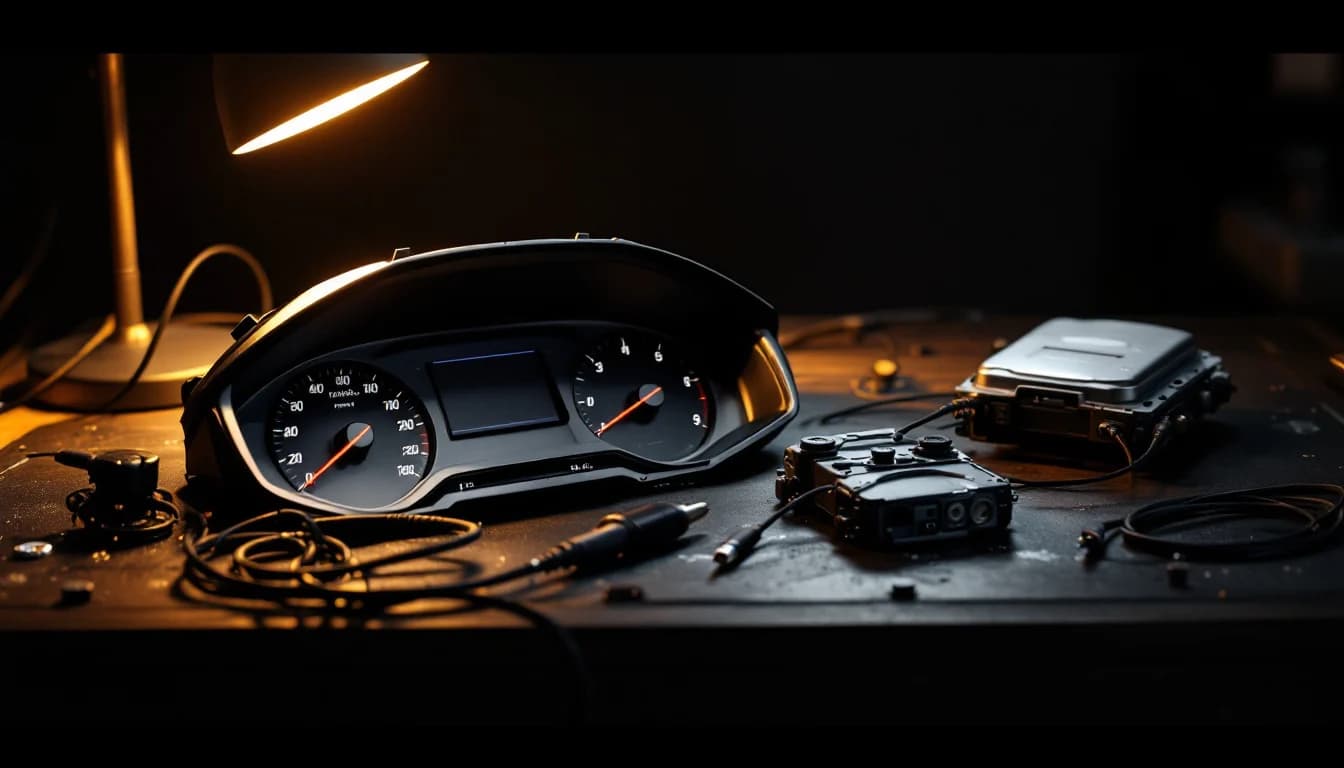
The instrument cluster genuinely does fail on Volkswagens, in ways ranging from dead pixels and dead gauges to complete communication loss. Because the cluster participates in the immobilizer relationship on most of these generations, a cluster failure can present as a no-start with no obvious cluster symptom at all.
The engine controller fails less often than it is blamed, but when it does on an immobilizer-participating platform, replacing it means re-establishing the security relationship, not merely swapping a part.
The comfort or body control module matters most on MQB, where it holds part of the picture. A fault there can produce security-related behavior that looks like it belongs to a different system entirely.
Low battery voltage deserves its own mention, because it mimics all of the above. Volkswagen electronics are notably sensitive to marginal voltage, and a battery that starts the car fine on a warm afternoon can produce communication faults and spurious security behavior on a cold morning. Confirming a healthy battery before condemning a module is free, and it is skipped constantly.
Cost Picture and Repair Paths
Irving-area planning ranges as of August 2026. These are not quotes. Volkswagen module work in particular depends on the immobilizer generation, which module is involved, whether a part is new or donor-sourced, and whether the adaptation is available to independent tooling. We give a firm number only after confirming the VIN.
| Situation | Likely Cause | Repair Path | Typical Range |
|---|---|---|---|
| Cranks, will not run, immobilizer light on, spare key works | Failed transponder in daily key | New key cut and programmed to the vehicle | $400–$700 European key |
| Cranks, will not run, both keys behave the same | Reader coil, antenna, or module-side fault | Diagnose before any part is ordered | Quoted on-site after inspection |
| Intermittent no-start, worse in cold weather | Marginal battery or communication fault | Verify supply and communication first | Diagnostic visit only |
| IMMO 4 Jetta needing a key added | Standard immobilizer adaptation | Port-based key adaptation, well supported | $400–$700 European key |
| IMMO 5 Jetta needing a key or module work | Protected data requiring direct module access | Bench read, data work, then adaptation | Quoted after VIN and module confirmation |
| Instrument cluster replaced on a Jetta | Cluster participates in immobilizer | Adapt cluster, re-establish key relationship | Quoted after VIN and module confirmation |
| MQB Taos or MQB Jetta module replacement | Distributed immobilizer across three modules | Bench work plus multi-module adaptation | Quoted after VIN and module confirmation |
| Donor cluster or ECU already installed, car will not start | Component protection binding the part to its donor | Adaptation attempt, feasibility confirmed by VIN | Dealer or specialist — may require an OEM server session |
| Current-model-year VW or restricted platform | Manufacturer-controlled access layer | Feasibility confirmed from VIN before any work | Dealer or specialist — may require an OEM server session |
| All keys lost on an MQB vehicle | No credential present, full data reconstruction | Bench data work, key generation, adaptation | Quoted after VIN and module confirmation |
The row people should read twice is the donor part row. If you already installed a used cluster or engine controller and the car will not start, the diagnosis is usually not difficult and the answer is usually component protection. What varies is whether the adaptation is reachable, and that is a VIN question rather than an opinion question.
The Honest Boundary
Every guide like this should say plainly where the limits are, so here they are.
Independent specialists can legitimately do a great deal of Volkswagen security work. The framework that makes that possible is credentialed access to manufacturer security data, administered for many makes through the National Automotive Service Task Force and its release model for qualified independent professionals (nastf.org). That is why a properly credentialed mobile specialist can perform work that people assume is dealer-only.
The limits are real nonetheless. The newest platforms, some MQB adaptations, and any operation gated behind a manufacturer online session may require dealer-level access that no independent tool replaces. When that is the case, the right answer is to say so from the VIN before anyone starts, not to attempt it and hand back a car in worse condition. Anyone who promises any Volkswagen module, any year, guaranteed, without seeing the VIN, is guessing with your money.
Two smaller honest notes belong here too. Reprogramming an emissions-related controller is a regulated activity, and the standards around onboard diagnostic systems and their reprogramming interfaces are maintained publicly by the Environmental Protection Agency (epa.gov) and the Society of Automotive Engineers (sae.org). And before condemning any module, it is worth checking whether the fault your vehicle exhibits is the subject of a manufacturer service action, since the National Highway Traffic Safety Administration maintains that public record (nhtsa.gov).
What a Mobile Volkswagen Module Visit Looks Like
We come to the car, which matters here because a vehicle with an immobilizer fault typically cannot be driven anywhere, and towing a non-running car to a dealership adds meaningful cost and days to any repair (aaa.com).
The visit starts with verification rather than parts. Battery and charging condition, communication with the modules, which keys the vehicle recognizes and which it rejects, and what the stored faults actually say across systems rather than in one module. On Volkswagens this stage frequently changes the plan, because a surprising number of "immobilizer failures" turn out to be supply or communication problems.
If key work resolves it, key work resolves it and the visit is short. If the job is genuinely module-side, expect a clear explanation of which modules are involved, whether bench access is required, and whether the adaptation is available to independent tooling on your specific vehicle before any part is ordered. The Federal Trade Commission's consumer guidance on scope and pricing in auto repair is a fair standard for that conversation (ftc.gov).
Ownership verification applies without exception. Immobilizer programming creates the ability to start a vehicle, so we require photo identification matching the vehicle paperwork plus registration, title, insurance, or a lease tied to the VIN. If you want to see how the same class of work looks on a make where the immobilizer lives in its own dedicated box, the guide on immobilizer module programming on Hyundai and Kia is a useful contrast to Volkswagen's distributed approach.
Frequently Asked Questions
What is the difference between IMMO 4 and IMMO 5 on a VW Jetta?
IMMO 4 covers the MK5 and much of the MK6 era and keeps a well-understood immobilizer relationship anchored around the instrument cluster, which independent tooling supports broadly. IMMO 5 arrives with the later MK6 and the MK7 and protects the underlying data far more strongly, so adding a key or replacing a module frequently requires reading data directly from a module on the bench rather than working entirely through the diagnostic port.
Why is a Volkswagen Taos different from an older Jetta for immobilizer work?
The Taos is built on the MQB platform, where the immobilizer is not a single module. The security relationship is distributed across the instrument cluster, the engine controller, and the comfort or body control module, with each holding part of the picture and cross-checking the others. Replacing any one of them has consequences for the other two, which makes the work multi-module rather than a single adaptation.
What is component protection and why did my used cluster not work?
Component protection binds certain modules to a specific vehicle. A protected module installed in a different car recognizes it is not where it belongs and restricts its own function until it is properly adapted to the new vehicle. That is why a perfectly good donor cluster or engine controller with the correct part number can still leave a car that will not start. The part is not broken; it has not been adapted.
Can component protection be cleared by an independent shop?
Sometimes. On many Volkswagen platforms the adaptation is performed through a manufacturer online session that authenticates the shop and the vehicle, and on those the access requirement is real and cannot be substituted with independent tooling. Which category your vehicle falls into is determined from the VIN and the specific module, and an honest shop confirms that before quoting rather than after.
My VW cranks but will not start and the immobilizer light is on. Is that a module?
Not necessarily, and it usually is not. The most common cause by a wide margin is a failed transponder in the key, and the fastest free test is trying your spare. If the spare starts the car, the daily key is the problem. If both keys behave identically, the next suspects are the reader antenna, low battery voltage, and only then a module.
Does a bad battery really cause immobilizer problems on a Volkswagen?
Yes, more often than owners expect. These electronics are sensitive to marginal supply voltage, and a battery that seems adequate on a warm afternoon can produce communication faults and security-related behavior on a cold morning. Verifying battery and charging condition costs nothing and should always come before condemning an expensive module.
Can you do Volkswagen immobilizer programming at my location in Irving?
Yes for the work that is reachable outside a manufacturer online session, and that covers a great deal of Jetta and Taos work. This is mobile service across Irving, Las Colinas, Grand Prairie, Coppell, and the surrounding cities, which matters because a car with an immobilizer fault usually cannot be driven. We confirm feasibility from your VIN first and verify ownership on-site before performing any secured work.
References
- IIHS — vehicle anti-theft technology and theft-pattern research: https://www.iihs.org
- NASTF — Secure Data Release Model and credentialed security data access: https://www.nastf.org
- ALOA — professional locksmith standards and ethical service boundaries: https://www.aloa.org
- SAE — vehicle electronics and reprogramming interface standards: https://www.sae.org
- EPA — onboard diagnostic system requirements and vehicle certification: https://www.epa.gov
- NHTSA — manufacturer service actions and vehicle recalls: https://www.nhtsa.gov
- FTC — auto repair scope, estimates and consumer rights: https://www.ftc.gov
- AAA — roadside assistance and towing cost guidance: https://www.aaa.com
If your Jetta or Taos will not start, is showing an immobilizer fault, or has a donor module installed that the car refuses to accept, call or text 817-842-1751 with your VIN and the part number of anything you already bought. We will tell you which immobilizer generation you have, whether the adaptation is reachable, and what it takes, before anybody commits. Mobile Volkswagen module service throughout Irving and the surrounding DFW cities.
Reviewed by a licensed automotive locksmith technician at Irving Locksmith Pros. Texas DPS Private Security regulated. Mobile service; ownership verification required.