Car Shuts Off While Driving in Irving: Ignition Switch, Key, or Something Else?
Car shuts off while driving in Irving TX? How to tell an ignition switch fault from a fuel or sensor problem, what each costs, and when to call a locksmith.
Short answer. If your car shuts off while driving and the dashboard, radio, and lights go dark at the same moment, the ignition switch or the key and cylinder are prime suspects. If the engine dies but the dash stays lit and the warning lights come on, the cause is more likely fuel, a sensor, or an engine-management fault — a job for a mechanic. As of September 2026 in Irving, ignition cylinder work typically runs $150 to $550, and a fresh key to factory specification runs $150 to $275 for a transponder key.
First: Get Safe
If your car has just shut off in traffic, the steering and brakes will feel heavy because the power assist has stopped. Both still work; they need more force. Put your hazard lights on, steer firmly to the shoulder, and press the brake pedal hard. Once you are stopped safely, you can think about why it happened.
If the car shut off on a highway such as SH-183, the President George Bush Turnpike, or I-635, stay in the vehicle with your seat belt on if there is no safe place to stand, and call for help. A roadside diagnosis is not worth standing next to live traffic.
The One Observation That Narrows It Down
An engine that shuts off while driving has dozens of possible causes, and most of them are not locksmith work. But one observation, made in the moment, splits the list roughly in half: what did the dashboard do?
- Everything went dark or dropped to accessory at once — gauges fell to zero, the radio cut out, the dash lights flickered or went out, and the car behaved as though you had turned the key back. That pattern points at the ignition switch, the key and cylinder, or the electrical path that feeds them.
- The engine stopped but the dash stayed lit — the gauges were still illuminated, the warning lights came on, the radio kept playing. That pattern points away from the ignition switch and toward fuel delivery, a sensor such as the crankshaft position sensor, the engine computer, or charging problems.
If you did not notice, that is normal; most people are looking at the road. The next time it happens, if it happens, glance at the dash before anything else. That single fact is worth more to whoever diagnoses the car than a page of guesses.
Ignition Switch Causes: What We Look For
A worn key in a worn cylinder
On turn-key vehicles, the key and the ignition lock cylinder wear together over years. A worn key sits loosely in a worn cylinder, and a bump in the road can rotate it far enough to drop out of the run position. The tell-tale signs are a key that wiggles noticeably in the ignition, a key that has to be jiggled to start the car, or a car that shuts off over the same pothole or railroad crossing every time.
The fix is often simpler than people expect: a new key cut to factory specification from the vehicle's key code, sometimes paired with repairing or replacing the cylinder. Our guide to an ignition that will not turn covers the repair-versus-replace decision in detail.
Heavy keychains
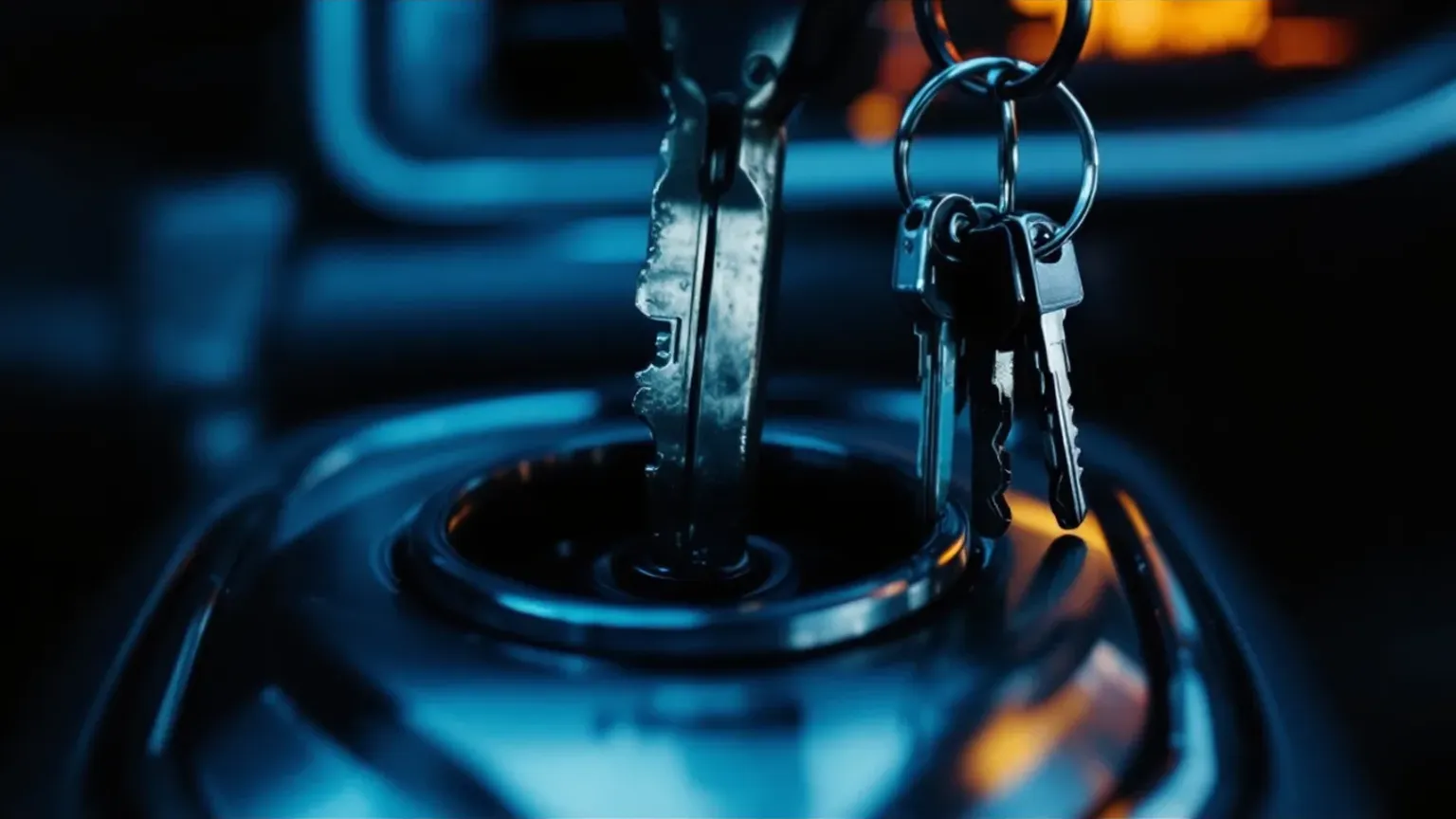
This is not folklore. In 2014, General Motors recalled roughly 2.6 million vehicles — including the Chevrolet Cobalt and HHR, Pontiac G5 and Solstice, Saturn Ion and Sky — because the ignition switch could move out of the run position under certain conditions, including a heavy keyring or a jarring event. When that happened, the engine and power steering and brake assist shut off, and the airbags could fail to deploy in a crash. The recall is documented in detail by the National Highway Traffic Safety Administration.
Most modern ignition switches are designed with more detent force, but the physics has not changed: weight hanging from a key in a turn-key ignition pulls on the switch every time the car hits a bump. If your key carries a heavy ring of house keys, a bottle opener, and a handful of loyalty tags, take them off and see whether the problem stops. It costs nothing to test.
The electrical side of the switch
Behind the lock cylinder sits the electrical ignition switch, which routes power to the run circuits. Its internal contacts can wear or overheat, especially on older vehicles, and a failing switch can cut power intermittently even when the key does not move. That typically shows up as the car dying and the dash going dark at random, sometimes along with flickering dash lights or a radio that resets. On some vehicles the electrical switch is a separate part from the cylinder; on others they are serviced together.
Open recalls
Before paying for any ignition repair, check your vehicle's VIN on the NHTSA recall lookup. If there is an open recall covering the ignition switch, the dealer repairs it at no charge. We will tell you to do this ourselves if it applies.
What About the Immobilizer?
People often ask whether the immobilizer — the anti-theft system that reads the chip in the key — can shut off a running engine. On the great majority of vehicles, it is designed to do the opposite: it decides whether the engine is allowed to start, and once the engine is running it does not shut it down mid-drive for safety reasons.
That is why an immobilizer fault almost always shows up as the car will not start, often with a flashing security light, rather than the car shut off while driving. If you have a no-start with a security light, our guide to the GM security light no-start and our immobilizer dash message decoder are the right next reads.
There is one nearby pattern worth knowing about: a car that starts and then dies within a couple of seconds. That is frequently the immobilizer allowing the crank and then cutting fuel because it did not verify the key. It is a different symptom from dying at speed, and we cover the diesel-truck version in our piece on a diesel that starts then dies immediately.
Push-Button Cars: A Different Story
On push-button start vehicles, there is no key in a cylinder to be bumped. If a proximity fob's battery dies or the fob leaves the car while driving — say a passenger gets out with it — the car will typically display a "key not detected" warning but keep running until you shut it off. After that, it will not restart without the fob.
So on a push-button car, a sudden shutoff at speed is very unlikely to be the key. It is more likely a fuel, sensor, electrical, or engine-management fault, and a mechanic is the first call. Where a locksmith does come in on push-button cars is the aftermath: a no-start with "key not detected," covered in our guide to push-to-start not working, and steering-lock failures on certain platforms, covered in our Nissan steering lock failure guide and our steering lock module cost guide by make.
Symptoms, Likely Causes, and Who Fixes It
| What Happened | Most Likely Cause | Who Fixes It | Typical Cost in Irving |
|---|---|---|---|
| Died over a bump, dash went dark, key wiggles in the ignition | Worn key and/or worn ignition cylinder | Automotive locksmith | New key $150–$275; cylinder work $150–$550 |
| Died over a bump, heavy keyring on the key | Keyring weight pulling the switch out of run | You (remove weight); locksmith if wear remains | Free to test |
| Died at random, dash flickered or went dark, radio reset | Failing electrical ignition switch | Locksmith or mechanic, depending on vehicle | Quote-based by vehicle |
| Died, dash stayed lit, warning lights on | Fuel delivery, crank sensor, or engine management | Mechanic | Varies |
| Died, battery and charging lights on, electrics faded | Charging system or battery | Mechanic | Varies |
| Push-button car died at speed | Almost never the fob; usually mechanical or electrical | Mechanic | Varies |
| Starts then dies within 2 seconds, security light | Immobilizer not verifying the key | Automotive locksmith | Quote-based |
| Will not start at all, security light flashing | Key chip, key memory, or immobilizer fault | Automotive locksmith | Quote-based |
The cost column uses our published bands where the job is ours. Where the answer is "mechanic," we do not guess at someone else's prices, because engine and fuel diagnoses vary too much by vehicle.
"When a customer tells me the car shut off, my first question is always whether the radio kept playing. If it went dead with the engine, I want to see the key and the ring it is on. If the radio kept going, I tell them honestly that they probably need a mechanic, not me, and I save them a service call." — a senior technician on our Irving crew
Diagnostic Steps You Can Take Before Calling Anyone
None of these require tools, and all of them make the eventual diagnosis faster and cheaper.
- Note the dash behavior the next time it happens, as described above.
- Take everything off the key except the key itself for a week of normal driving.
- Check whether the key moves in the ignition. With the engine off, put the key in and gently rock it. A little play is normal; a key that flops or rotates easily toward accessory is not.
- Try your spare key, if you have one. A spare that has seen less use is often cut closer to factory specification. If the problem stops with the spare, the original key is worn.
- Look for a pattern. Same bump, same turn, same speed? Only when hot? Only in rain? Write it down.
- Check the VIN for open recalls on the NHTSA recall lookup.
- Note any warning lights or messages, and whether the car restarts immediately afterward.
A car that shuts off and restarts immediately every time points one way; a car that dies and will not restart for twenty minutes points another. Both are useful facts.
What an Ignition Repair Visit Looks Like
When the evidence points at the key and cylinder, the job is well within mobile locksmith work in most cases. We verify ownership, inspect the key and the cylinder, and decode the key where possible. The usual outcomes are:
- A new key cut to factory specification, programmed to the car if it has a transponder. This alone fixes a surprising number of wiggle-and-die complaints.
- Cylinder repair or rekeying, restoring the internal wafers so the key sits firmly.
- Cylinder replacement when the housing itself is worn or damaged, with the new cylinder keyed to your existing key where the vehicle allows it.
When the evidence points at the electrical switch, it depends on the vehicle. On some it is a straightforward part we can replace; on others it is buried behind the column in a way that belongs in a shop. We tell you which before we quote. See our ignition repair service for the vehicles and jobs we handle on-site.
When to Stop Driving the Car
An engine that shuts off while driving is a safety problem, not an inconvenience. If it has happened more than once, or once at highway speed, we recommend limiting driving until it is diagnosed — especially on high-speed roads and in heavy traffic. If the cause turns out to be a worn key or a heavy keyring, the fix is quick. If it is not, you want to know before it happens in the middle of an intersection.
Frequently Asked Questions
Why does my car shut off while driving and then restart?
If the dash and radio go dark at the same moment the engine stops, the ignition switch or a worn key and cylinder are likely causes, especially if it happens over bumps. If the dash stays lit, fuel delivery, a sensor, or engine management is more likely. Note what the dash does the next time it happens and tell whoever diagnoses the car.
Can a heavy keychain really make a car shut off?
Yes, on turn-key ignitions. In 2014 General Motors recalled roughly 2.6 million vehicles, including the Chevrolet Cobalt and HHR, because the ignition switch could move out of the run position with a heavy keyring or a jarring event. Removing extra weight from the key is a free first test.
Can the immobilizer shut off my car while I am driving?
On the great majority of vehicles, no. The immobilizer decides whether the engine may start and is designed not to shut down a running engine. Immobilizer faults usually appear as a no-start or a car that starts and dies within a couple of seconds.
How much does ignition switch repair cost in Irving, TX?
As of September 2026, ignition cylinder repair or replacement typically runs $150 to $550 in Irving depending on the vehicle, and a new transponder key cut to factory specification runs $150 to $275. Electrical ignition switch replacement is quoted by vehicle because access varies widely.
Is it safe to keep driving a car that shuts off?
We recommend limiting driving until the cause is found, especially at highway speed. When the engine stops, power steering and brake assist stop too, and on some vehicles airbag readiness can be affected. Get it diagnosed promptly.
Can a push-button start car shut off if the key fob battery dies?
Generally not while driving. Most push-button vehicles display a key-not-detected warning and keep running until you switch the engine off, then refuse to restart without the fob. A push-button car that dies at speed usually has a mechanical or electrical fault rather than a fob problem.
Should I call a locksmith or a mechanic if my car shuts off?
If the dash goes dark with the engine and the key is loose or worn, start with an automotive locksmith. If the dash stays lit and warning lights appear, start with a mechanic. If you are not sure, call us, describe what happened, and we will tell you honestly which one you need.
Not Sure Which Problem You Have?
Describe what happened and we will tell you whether it sounds like our kind of job. Irving Locksmith Pros handles key, cylinder, and ignition work on-site across Irving, Las Colinas, Grand Prairie, Euless, Farmers Branch, and the surrounding DFW cities, and we quote before we roll.
Call or text 817-842-1751 or email contact@irvinglocksmithpros.com with the year, make, model, and what the dash did when the engine stopped.
References
- National Highway Traffic Safety Administration — recall lookup by VIN and the 2014 GM ignition switch recall: https://www.nhtsa.gov/recalls
- Insurance Institute for Highway Safety — airbag and crash protection research: https://www.iihs.org
- AAA — breakdown safety and what to do when your car stalls: https://www.aaa.com
- SAE International — vehicle electrical and ignition system engineering standards: https://www.sae.org
- Federal Trade Commission — written estimates and consumer protection in repair services: https://www.ftc.gov
- Associated Locksmiths of America (ALOA) — professional automotive locksmith standards: https://www.aloa.org
- National Automotive Service Task Force (NASTF) — secure access to key codes and vehicle security data: https://www.nastf.org
Reviewed by a licensed automotive locksmith technician at Irving Locksmith Pros. Texas DPS Private Security regulated. Mobile service; ownership verification required.