
HD Diesel Will Not Start After a Battery Swap or Jump in Irving, TX
2026 guide to a heavy duty diesel that will not start after a dual-battery swap or jump in Irving TX. Immobilizer relearn, module faults and real costs.
The Short Answer
As of August 2026, a heavy-duty diesel that will not start after a battery change or a jump is usually one of three things, and they are cheap to tell apart before anyone spends money. Either the anti-theft system needs a relearn because the security handshake was interrupted, or one of the truck's modules came out of the voltage event confused and has to be re-woken or reprogrammed, or the second battery is quietly bad and the truck simply does not have the amperage a diesel needs to fire. The diagnosis is a short on-site job. The fix ranges from free — a relearn procedure you can sometimes do in the driver's seat — up through our published key bands of $150–$275 and $300–$500 if a key or fob has to be regenerated, or $100–$400 in programming labor if a module needs reflashing. Call 817-842-1751 and we will tell you which one you are looking at before we roll a truck.
We wrote a general guide to no-starts after a battery change that covers passenger cars. This one is specifically about heavy-duty diesels, because they fail differently and more often, and the reason is the second battery.
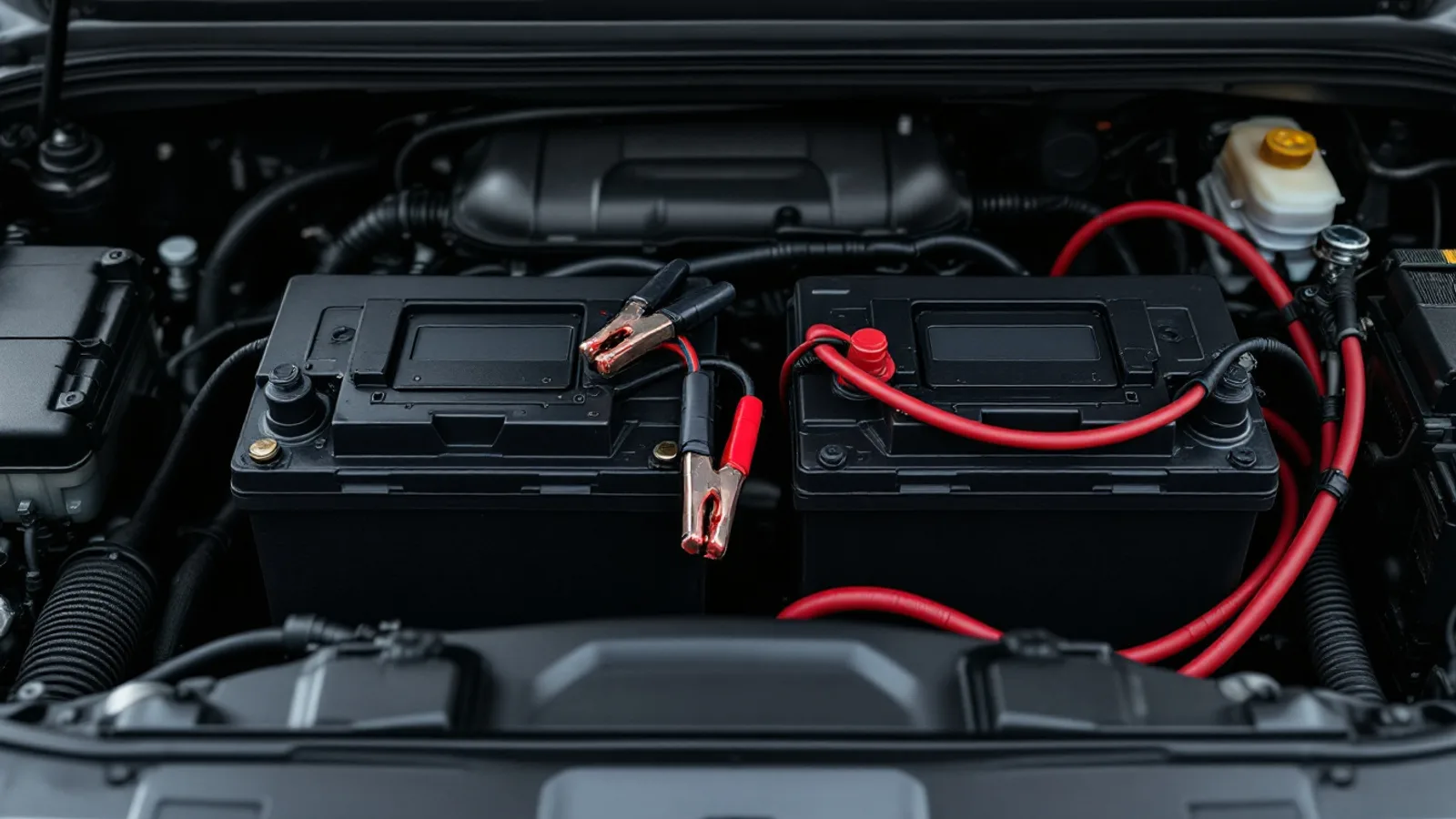
Why the Dual-Battery Setup Changes Everything
A car has one battery. A Cummins, Power Stroke or Duramax pickup has two, wired in parallel, and that arrangement creates failure modes a single-battery vehicle simply cannot have.
The batteries can disagree. Two batteries in parallel share a load, but they do not always share a state of health. When one is failing, the good one drains into it. The truck can read a plausible resting voltage and still collapse to five or six volts the instant the starter engages — which on a diesel draws far more current than a gas engine because of the compression it has to overcome and the grid heater or glow plugs it has to feed first.
That voltage collapse is what confuses modules. Automotive control modules are designed to operate within a supply window. Drop below it briefly and they can reset, lose a stored value, or hang in a state where they are powered but not communicating. The security module is one of these. So is the body controller, the instrument cluster and the engine computer. A truck that spent ten seconds at six volts during a cranking attempt has effectively been asked to reboot mid-thought.
Replacing one battery instead of both makes it worse. Pairing a new battery with a two-year-old one in parallel is a well-known way to kill the new one early and to keep the truck marginal in the meantime. If someone changed one battery and the truck has been strange since, that is a genuine lead, not a coincidence.
Jump-starting a diesel is harsher than jumping a car. More current, more spike potential on disconnect, and on the trucks we see most in Irving, more computers to be upset by it.
Triage Table: Match Your Symptom to the Cause
Use this before anyone spends money. The three observations across the top are free.
| What the truck does | Security lamp on key-on | Most likely cause | Who to call |
|---|---|---|---|
| Cranks strong, never fires | Stays lit or flashes | Anti-theft lost its handshake | Automotive locksmith |
| Cranks strong, fires and dies in 1-3 seconds | Any abnormal behavior | Immobilizer shutdown | Automotive locksmith |
| Cranks, cluster full of unrelated faults | Often abnormal | Module browned out by voltage drop | Locksmith or module specialist |
| Cranks slow, lights dim hard | Normal bulb check | Weak or mismatched battery pair | Battery service or diesel shop |
| Starts on a jump, dies when cables come off | Normal bulb check | Charging or battery supply | Diesel shop |
| No crank at all, nothing happens | Varies | Interlock, ignition switch or dead batteries | Diagnose before dispatching |
The Three Causes, in the Order We Rule Them Out
1. The anti-theft system lost its handshake
What it looks like: the truck cranks strongly — good speed, no struggle — and either never fires at all or fires and dies within one to three seconds. A security or immobilizer indicator on the cluster may flash, stay lit, or behave differently than it did last week. Everything else on the truck works normally.
The start-then-die pattern in particular is close to diagnostic on its own. The engine physically can run — it just ran — and something shut the fuel off deliberately. That is the anti-theft system doing exactly its job with bad information. We walk through that specific symptom in detail in diesel truck starts then dies immediately.
What it costs: on many platforms a key relearn procedure resolves it, and on some it is a documented sequence with the key in the run position for a set period. If the security module has genuinely lost its key data, keys have to be re-taught, which prices at $150–$275 for a transponder key or $300–$500 for a smart or proximity fob.
2. A module came out of the voltage event confused
What it looks like: the truck cranks but shows implausible faults — a cluster lit up with warnings that have nothing to do with each other, gauges that read wrong or not at all, communication errors across multiple modules, or a truck that behaves differently on the second attempt than the first. Sometimes there is no crank at all and no obvious reason.
This is not the same as a failed module. A module that has been browned out is usually fine hardware that needs to be re-established on the network, and on some platforms the correct move is a controlled power-down long enough for every module to fully sleep, then a proper wake sequence. That costs nothing but patience, and it is worth trying before anyone buys a part.
Where it is a genuine module problem, programming labor runs $100–$400 and the part is separate — the full breakdown is in our diesel ECM and PCM programming cost guide. An immobilizer or security module specifically is the same class of work we describe on the immobilizer control module page, though the platform differs.
3. The batteries are the actual problem
What it looks like: the crank is slow, laboring, or fast at first and then dragging. The truck may start on a jump and die when the cables come off. Lights dim dramatically during cranking. On a cold morning it is worse than in the afternoon.
This is the most common of the three and the one people are least willing to believe, because "I just changed the battery" feels like it rules the battery out. It does not — it changed a battery. A load test on both batteries individually, with them separated rather than tested as a pair, settles this in a few minutes. This is not locksmith work and we will tell you so plainly rather than selling you a key you do not need.
Diagnostic Steps You Can Do Before You Call
None of these require tools you do not already have on a work truck, and any one of them can save you a service call.
Watch the security indicator through a full key cycle. Key on, do not crank. On most platforms the security lamp illuminates for a moment during the bulb check and then goes out, meaning the truck recognizes the key. If it stays lit, flashes continuously, or never illuminates at all, that is anti-theft, not fuel or batteries. Note exactly what it does — it is the single most useful thing you can tell us on the phone.
Try the other key. If a second key starts the truck, the first key or its transponder is the problem, not the truck. This one test eliminates half the diagnostic tree in thirty seconds, and it is the strongest argument we know for keeping a programmed spare key on a work truck.
Listen to the crank speed. A healthy diesel crank is fast and even. If it sounds slow or uneven, stop chasing the anti-theft system and get the batteries load-tested.
Check what the fob does. If the fob no longer locks or unlocks the doors, and it did last week, that points at the fob battery or the fob itself rather than the truck. Our guide to a fob that stopped working after a battery replacement covers the fob-side version of this.
Note what changed and when. Battery replaced by whom, one or both, jump-started by whom, cables on for how long, anything installed recently. If an upfitter has been in the truck lately — winch, inverter, plow controller, telematics — say so, because that opens a different branch we cover in no-start after a winch or upfitter install.
Do not keep cranking. Repeated failed attempts on a diesel drain the batteries you are trying to diagnose and can turn one problem into two.
When to Call Someone, and Which Someone
Call an automotive locksmith when the crank is strong, the security light is behaving abnormally, the truck starts and dies, or a second key behaves differently from the first. That is our work and it is what we do on site.
Call a diesel mechanic or a mobile battery service first when the crank is slow, the lights dim hard, or the truck only runs with cables attached. We would rather route you correctly than take a dispatch that ends with us telling you to call someone else.
Call either of us — not a tow truck — before anything moves. A heavy-duty tow in the DFW corridor runs $150–$300 and up, and on an upfitted chassis cab it can be more, which is frequently larger than the repair. Both of the diagnoses above happen where the truck sits.
The Fleet Version of This Problem
If you run diesels out of a yard in Irving or Grand Prairie, this failure has a seasonal shape. It clusters after the first genuinely cold morning of the year and after any truck sits over a long weekend, because both conditions expose a weak second battery that was passing unnoticed all summer.
Three habits eliminate most of it. Load-test both batteries in every diesel once before winter, individually rather than as a pair. Replace batteries in matched pairs, not one at a time. And make sure every truck has two programmed keys, because "try the other key" is a diagnostic step a fleet with single-key trucks cannot perform. Our fleet key management guide covers how to inventory that without turning it into a project.
Frequently Asked Questions
Why won't my diesel start after I changed the battery? Three common causes. The anti-theft system may need a relearn because the security handshake was interrupted during the power loss. A control module may have come out of the voltage drop in a confused state and need to be re-woken or reprogrammed. Or the second battery in the pair is bad and the truck no longer has the cranking amperage a diesel needs. The security indicator's behavior on key-on separates them quickly.
Does a dual-battery truck need both batteries replaced at the same time? It is strongly preferable. Two batteries in parallel share a load but not necessarily a state of health, and a new battery paired with an aging one drains into it and ages prematurely. Mismatched pairs are one of the most common causes of an intermittent no-start on a heavy-duty diesel.
Can jump-starting a truck damage the computers? It can contribute to problems, particularly if voltage collapses badly during cranking or if cables are disconnected under load. Modules are usually not destroyed, but they can reset, lose stored values, or hang in a non-communicating state. That often reads as a mysterious no-start with implausible cluster faults.
How do I know if it is the immobilizer and not something mechanical? Watch the security lamp on key-on before cranking. Normal behavior is a brief bulb check that then goes out. A lamp that stays on, flashes continuously, or never lights at all points at anti-theft. Cranking strongly and then dying within a second or two is also close to diagnostic for a security shutdown, because the engine has just proven it can run.
What does it cost to fix an immobilizer relearn on a diesel truck? If a relearn procedure resolves it, the cost is minimal. If keys have to be regenerated, our published bands apply: $150–$275 for a transponder key and $300–$500 for a smart or proximity fob. If a module needs reflashing, programming labor runs $100–$400 plus the part. We confirm which after a VIN check and an on-site scan.
Should I tow the truck to a dealer? Almost never as a first move. A heavy-duty tow runs $150–$300 and up before any repair begins, and both the anti-theft and module-wake diagnoses happen at the truck. Get the diagnosis where the truck sits, then decide.
My truck starts with a jump every time but dies when the cables come off. Is that the key? No. That pattern is electrical supply, not security — the truck is running fine while it has enough voltage and stopping when it does not. Get the batteries and charging system tested. This is one where we will tell you it is not our job.
Get It Diagnosed Where the Truck Sits
If a diesel is down in Irving, Las Colinas, Grand Prairie, Euless, Coppell or Farmers Branch after a battery change or a jump, call 817-842-1751. Tell us the VIN, what the security light does on key-on, and how the crank sounds. Those three facts usually tell us what you are dealing with before we dispatch — including when the honest answer is that you need a battery, not a locksmith.
See our immobilizer and no-key-detected page and our emergency locksmith page for coverage and response.
References
- National Automotive Service Task Force (NASTF) — credentialed vehicle security-data access: https://www.nastf.org
- SAE International — vehicle electrical systems and on-board network standards: https://www.sae.org
- National Highway Traffic Safety Administration — vehicle anti-theft and immobilizer standards: https://www.nhtsa.gov
- AAA — battery, jump-start and roadside service guidance: https://www.aaa.com
- Associated Locksmiths of America (ALOA) — professional automotive locksmith standards: https://www.aloa.org
- Insurance Institute for Highway Safety — vehicle anti-theft technology research: https://www.iihs.org
- Federal Trade Commission — hiring a service provider and avoiding scams: https://www.ftc.gov
Reviewed by a licensed automotive locksmith technician at Irving Locksmith Pros. Texas DPS Private Security regulated. Mobile service; ownership verification required. Diagnostic guidance is general — your truck is confirmed by VIN and on-site scan.